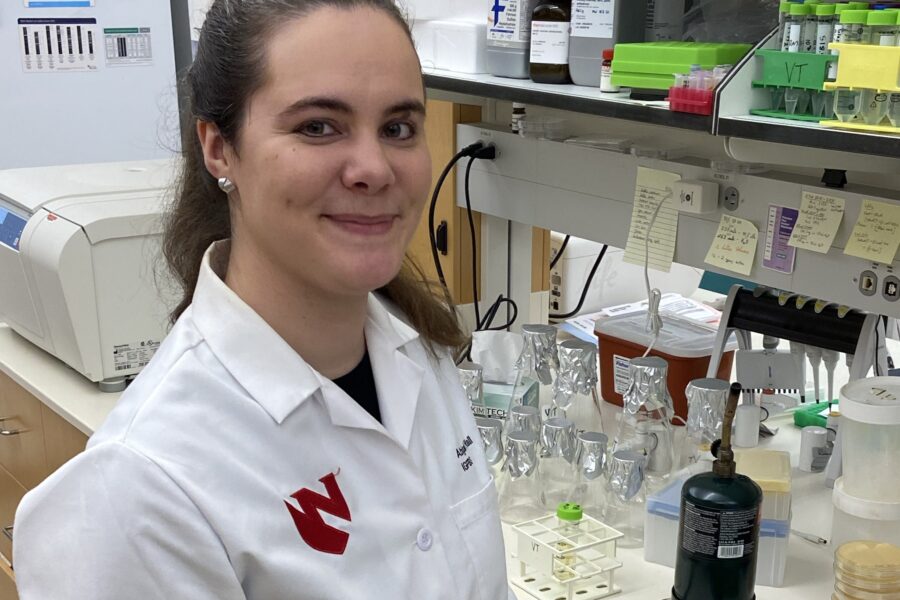
Abigail Hall is a PhD student studying Staphylococcus aureus in the lab of Vinai Thomas, PhD, associate professor of pathology, microbiology and immunology. She recently earned a one-year predoctoral fellowship from the American Heart Association. Let’s talk to her about how she earned this award and what receiving such a fellowship means to her career.
How did you get this fellowship and what advice would you give to someone looking for or applying for one?

I would advise other students to ask other students and PIs about which fellowships PhD students in their field have received in the past and ask for their advice and guidance. Within the pathology, microbiology, and immunology department we have a great community and a very collaborative environment. You are able to get feedback from all of these different people with different specialties. It’s a fantastic environment to learn and grow in. … Many students have come through this program, and over time many faculty mentors and PIs have gotten a feel for what type of fellowships exist for PhD students. So, the community brought this award to my attention. I was able to learn about all the grants and fellowships students within our department had applied to and received in the past. As a result, there were multiple students and faculty I could talk to and say, “Hey, what makes a good application?” There was a lot of support within my department.
How much do you think receiving an award like this is “the science” and your project, vs. putting together an application or “grantsmanship”?
Something important to keep in mind is at every single stage of your career, every grant you apply for is different. You need to design your applications for whichever specific award you are applying for. That is a skill, and it’s a skill that PhD students begin to develop in graduate school. There are a lot of skills that we are also developing, especially scientific writing. Writing about your science is a skill you continue to develop and improve all of your science career. Learning to tailor a grant or a fellowship application specifically to whichever funding source you are applying to is an additional, equally valuable skill.
One of benefits of working in my department, when it comes to the American Heart Association fellowship that I received, is my PI already was aware of what the AHA looks for in a predoctoral fellowship application. I had guidance from him, as well as other members of the department.
People might wonder, I study bacteria, and I got an award from American Heart Association. But infective endocarditis, an infection/inflammation of the inner surface of the heart caused by S. aureus bacteria, is a major concern for the American Heart Association.
I wouldn’t have necessarily known to apply for this fellowship, but that is something where the experience and advice from my department and my PI was invaluable.
How did the fellowship help you do the work you wanted to do or pursue your goals? What did it mean to you that you had your own funding?
Most predoctoral fellowships are training grants. This is fantastic, because funding is going toward my training, helping support my salary, and allowing me to travel. Basically, this funding allows me to be here and learn. Every dollar I bring in is another dollar our lab can use for equipment, reagents, and materials. It’s very satisfying to be able to give back and contribute to the training environment. This summer I was able to travel to a conference in Barcelona using the funds from my fellowship and share ideas with people from around the world! It was an absolutely fantastic experience. I was talking to people and able to say, “I’ve read your papers!” and ask a ton of questions.
Finally, it is a measurable outcome of success. I mean, I know I love my research. But it is gratifying for this large organization to say I am doing something right.
Can you tell us about your research in the most lay terms possible, and how did you go down this path of study?
I like to say my research looks like immunology, then you look closer and it is metabolism, and then you look even closer and its actually chemistry.”
“One of the reasons Staphylococcus aureus is a problem is it is very resistant to oxidative stress – which is what white blood cells use to kill bacteria as part of the immune system response. Normally, a white blood cell eats the bacteria and rapidly bombards it with high levels of oxidative stress – kill it with fire! But staph can sometimes survive this attack. It sometimes escapes the immune system and goes on to infect other tissues. My research is to figure out how staph are able to survive this high level of stress (probably thanks to a protein regulator called Spx and some fun thiol chemistry). … It was supposed to be a small side project, but I got some unexpected results and that drove this into becoming my main project.
Anything else you’d like PhD students to know about applying for fellowships or training grants?
When it comes to PhD students vs. postdocs, vs. professors, the grants you are applying for at every level are different from each other. For predoctoral awards you are not only applying with your science but applying with your mentor … your mentor is being evaluated along with you. They really need to be roped in early, as they are a major determinant of your success. My mentor, Dr. Vinai Thomas, has taught me that you need to have good science, good scientific writing, and a good application. You cannot sacrifice one for the others in any direction. Each are equally important.