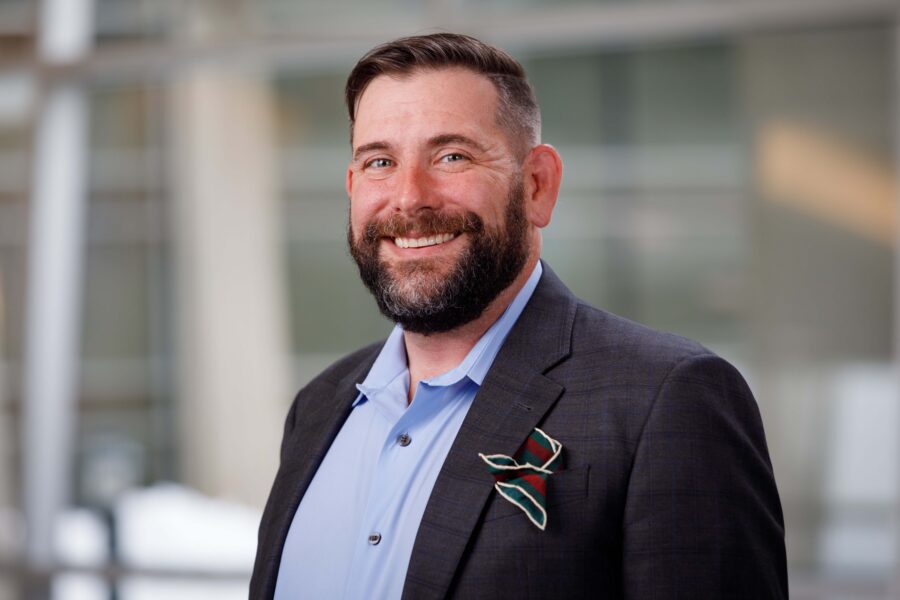
UNMC’s Josh Santarpia, PhD, a leading expert in aerosol transmission of disease and detection of bioaerosols, has been chosen as a recipient of grant funding to evaluate the real-world effectiveness of far-UVC light as a pandemic countermeasure.
Dr. Santarpia is a professor of pathology, microbiology and immunology at UNMC, associate director for academic affairs for the Global Center for Health Security and director for UNMC’s Medical Science Interdepartmental Area graduate programs.
The nonprofit organization Blueprint Biosecurity announced the recipients of its Exposure of Human Aerosols to far-UVC Light for pathogen Elimination (EXHALE) program awards in October.
Blueprint is awarding approximately $1 million in grants to fund two research teams to evaluate far-UVC’s effectiveness in real, human-generated respiratory aerosols. Dr. Santarpia’s UNMC team will study both influenza and SARS-CoV-2, while a team from Emory University and Virginia Tech will study the far-UVC technology’s effect on influenza.
Far-UVC are wavelengths of ultraviolet light (200-235 nm) that can inactivate airborne pathogens, including viruses, bacteria and fungi. Unlike conventional UV light, far-UVC’s limited penetration depth prevents it from reaching living skin cells. This property enables far-UVC to inactivate pathogens continually in occupied spaces, creating layers of protection without disrupting normal activities.
While existing laboratory studies have demonstrated far-UVC’s germicidal properties against various pathogens on surfaces and in lab-generated aerosol droplets, this research will provide critical data on far-UVC’s effectiveness against the complex aerosols humans actually produce when breathing, talking and coughing.
Dr. Santarpia said: “This award allows us to rigorously evaluate far-UVC against both influenza A and SARS-CoV-2 in conditions that mirror actual transmission scenarios. We’re honored to contribute evidence that could inform how we protect communities during future outbreaks.”
Said James Montavon, far-UVC deputy director of Blueprint Biosecurity, “By generating the data needed to deploy far-UVC broadly, we’re building the evidence base for a technology that could protect entire communities in the event of a future airborne pandemic.”
Following a competitive review process, Blueprint selected research teams to build the evidence base needed to evaluate far-UVC’s potential for deployment in schools, hospitals and public spaces. An initial readout of results is expected in mid-2026.
Josh, congratulations! I look forward to seeing the results of your study.
Super exciting work Josh. Congratulations!
Congratulations Dr. Santarpia! (Josh)
Congratulations!
Congratulations!
Congrats Josh! This is great news!
This is incredible – congratulations, Dr. Santarpia!