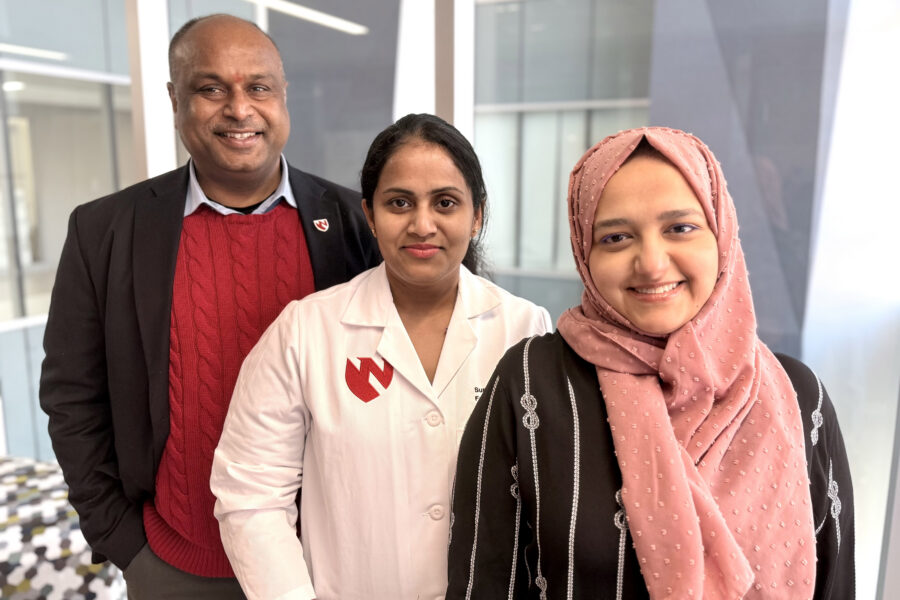
A new $800,000, three-year grant from the U.S. Department of Defense will allow a team of researchers from the UNMC College of Dentistry to explore mechanisms to deal with pain mitigation in cases of severe trauma.
Sangamesh Kumbar, PhD, Sama Abdulmalik, PhD, and H. M. Suranji Wijekoon, PhD, are co-principal investigators on the study, which dovetails with their ongoing efforts to repair and regenerate polytrauma – traumatic injuries or wounds that destroy bone, muscle, skin and nerve tissue, often occurring in car accidents, explosions or other combat injuries, and violent attacks.
Dr. Kumbar, associate dean for research at the college, said pain mitigation is an important consideration in cases where multiple tissue types must be repaired and regenerated.
“We want to create a unique niche where we can concurrently repair all those tissues without contaminating each tissue,” Dr. Kumbar said. “Now, we have advanced into the stage of how to manage the pain associated with this polytrauma.”
The team already has created molecules that are targeting the nicotinic receptors, which is crucial for pain mitigation.
“Bone healing can be achieved,” he said. “The bigger problem is nerve, muscle and nerve-muscle innervation. We are trying to break it down and study the interplay.”
For example, he said, in nerve healing, Schwann cells are involved, which produce cytokines that influence the behavior of other cells.
But Schwann cells are “finicky,” Dr. Kumbar explained. “They can take a regenerative pathway or a pain pathway. It is a very complex phenomenon. Not much is known. That’s why there are no great pain medications out there for polytrauma. When we study the complex phenomena, we may end up with promising leads.”
The grant will allow the team to better understand the mechanism behind the regenerative process in a polytrauma, Dr. Abdulmalik said.
“When we look at polytrauma, we don’t have one source of damage. We have layers of damaged tissue that we have to repair. This grant will help us in understanding what mechanisms get activated or provoked by our treatment, so it will help us upgrade and improve the treatment.”
Dr. Wijekoon said the layers of different tissue involved in polytrauma make regenerative treatment a difficult problem to address.
“We are trying to enhance our capacity to address this issue,” she said. “We have preliminary studies and have come to some conclusions. With this grant, we are planning to explore the pathways and the communication between tissues during regeneration. Specifically, we’ll explore pathways-based, therapeutic-based and regenerative aspects of healing tissue in polytrauma.”
Dr. Kumbar called the team’s efforts a translational approach.
“As we dive into this, we are seeing some patterns — what is working, what is not working, how we should improve. It is laying the foundation. Pain is a complex phenomena. Scarring and persistent infection are big problems. We could spend our entire life researching these various mechanisms.
“This multiyear grant allows the group to begin with simple, controlled conditions and then layer in complications. This gives us a clear view of the body’s repair pathway as we test new molecules, setting the groundwork for future precision therapies.
The team hopes by the end of the grant period to have identified molecules that can be implemented as part of a biomaterial platform for polytraumatic wounds including drugs to promote healing in a safe and effective way.
“It will lay that foundation to move forward,” Dr. Kumbar said.