This story appeared in the department’s 2025 annual report
Allison Cushman-Vokoun, MD, PhD, professor and director of Diagnostic Molecular Pathology and Human Genetics, has seen next-generation sequencing (NGS) transform the molecular pathology laboratory in the 10 years since it was launched.
“When I started in 2009, everything was a single-gene test,” she said. “Which meant you had one gene where you were looking at a specific mutation or a specific change and those assays were time-consuming, but you would do all this work for one change or one mutation in one gene. And that was kind of how molecular worked.”
But she said change was on the horizon. Two companies, Ion Torrent and Illumina, were starting to introduce their technologies into the clinical lab space, “and clinical labs especially in the bigger cancer centers were starting to bring these technologies in and developing these next-generation sequencing panels using what we call high-throughput sequencing, where you would pick out several targets in 50 different genes or even 100 different genes. Now we’re doing up to 300 genes, and some people are doing up to 700 some genes where you could use this high-throughput technology to really assess mutations throughout all these different cancer-related genes.”
They launched the first assay in 2015 on an Ion Torrent system called PGEN, and ran that for a few years before adding NGS assays for acute myeloid leukemia.
They have been increasingly busy as their capabilities grew. “We’ve moved from maybe doing one run to maybe two runs a week on patients up to doing one run a day now because it’s become so important to classifying and treating these myeloid neoplasms,” she said, adding that there are targeted therapies now for some of the gene mutations.
The lab acquired an Illumina sequencer called the NET-Seq and started developing a large gene panel. “We completed that validation not quite two years ago. We are running about 337 genes off that now,” she said. “That’s being used for a lot broader cancers, things like pancreatic cancer, prostate cancer, more genital-urinary cancers, female cancers where there’s different targets not on the smaller panels. And also for potential clinical trial enrollment. There are more targeted therapies now, more clinical trials, so this larger panel is really geared for that, in certain kinds of cancers.
“We also transitioned from that smaller 50-gene (assay) to a different type of 50-gene assay that does a lot more targets and is very rapid—we can get it done in a day or two. We can really rapidly profile solid tumors like melanomas or lung cancers and the myeloid neoplasms, and within 3 to 5 days we can have answers. Going from one single-gene assay that took a couple days to run to now being able to do anywhere from 50 to 300 genes in a week or two depending on the panel is really kind of amazing. It’s really done a lot of good.”
She said next-generation sequencing is also being used in the HLA lab, looking at bone marrow transplant candidates and for some high-resolution typing, so there has been tremendous growth over the past 10 years. “I think it is pretty impressive. We couldn’t do it without all of our technologists, the support of the department, the support of the hospital, the support of the cancer center,” she said. “The oncologists have been really great partners to work with. They like having it here; if they have questions they can call us. So it’s been a large group of people and programs that have helped us be able to do this and continue to do this.”
She said third-generation NGS is in use in the Nebraska Public Health Laboratory. “Pete Iwen and Emily McCutchen have been using Nanopore sequencers for quite a while now. It’s really amazing technology. We aren’t doing that here yet. We’re still using the Illumina and the Ion Torrent.” But she said Dr. Jesse Cox is looking into Nanopore sequencers for his lab.
Dr. Cushman-Vokoun said she’s looking forward to expanding their big panel to an even bigger panel. “The Illumina, the next year and a half, they have a new version of the assay. In that will be something called homologous recombinant deficiency or HRD, which is looking at DNA repair within the cell and if you have problems with DNA repair and genetic instability and telomeric imbalance, all these different things that can tell you if you have recombination, and there’s a certain drug class that’s being used in tumors that have what we call HRD. So that will be in the assay. So that’s one of our targets, growing that assay.
“We’ve also been evaluating lymphoma panels to complement our myeloid panel. And so Dr. Ketav Desai, who joined us this summer and who was my fellow last year, he is going to be hopefully working on that.”
She said they are also using next-generation sequencing now to do single-gene assays. “We can run a whole big panel of different genes that we’ve developed through a computer and bioinformatic, Dr. Zhang, what we call bioinformatically masking, where we only look at data for a single gene. So it saves money because you’re running a bunch of genes at the same time, so you only have to develop one assay, but you can analyze the different genes. We’re actually moving a lot of our single genes to next-generation sequencing as well.”
The lab is also looking at an assay for circulating tumor DNA, in which tumors release DNA into the blood especially after treatment. Next-generation sequencing can be used to evaluate the blood for variations or mutations in genes. “It’s a very difficult validation; it takes a very highly sensitive assay. But if you can’t get tissue on a patient, or if there’s not enough tissue, you can just do a blood draw. And there are companies doing that right now that we send to. But that’s something on our radar that we might think about doing.
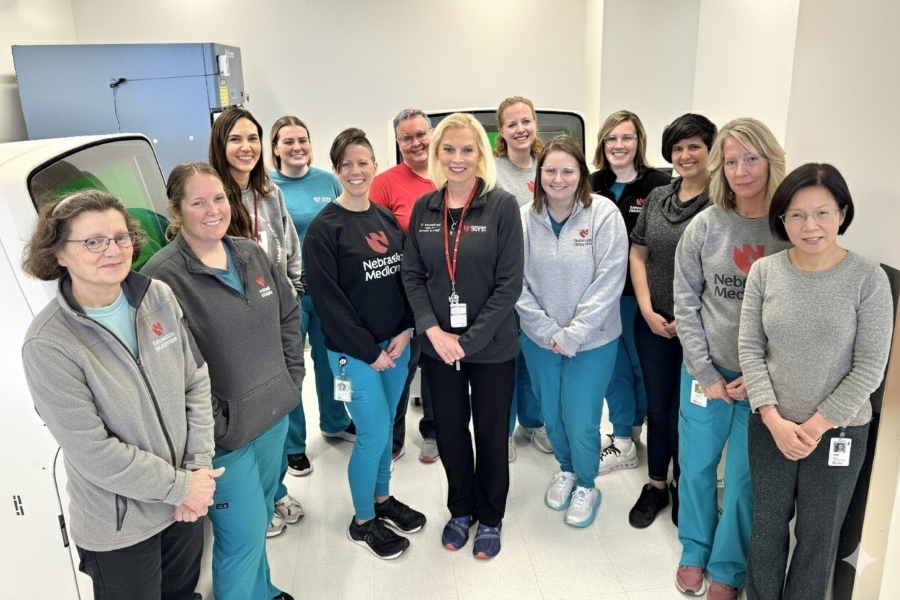
“So we have lots of things on the agenda,” she said. “But as we bring on more assays and they get higher volumes, so you got to keep up with all the clinical work, so we’re very busy right now, and trying to validate assays and bring on assays while you’re trying to keep the current assays running is challenging. But we have great staff. We have about eight or nine technologists trained in next-generation sequencing. And we have HLA technologists trained in the next-generation sequencing that they’re doing.” It’s also helpful that companies have streamlined the assays, adding automation that gives technologists more time for developing new assays or learning.
Dr. Cushman-Vokoun said her lab now has four types of NGS sequencers, two Illumina and two Ion Torrent.” “These instruments aren’t cheap. Some places choose to send this out because they don’t want to spend the money, but our hospital has been very, very supportive of the lab in doing this. But I think what also has really benefited us in being able to do this was having so many wonderful technologists, and Sharlene Rapp, who was our NGS coordinator and now is our lead technologist. We would not have been able to do this without their support and knowledge and dedication to this.”
Another key was adding Dr. Weiwei Zhang as bio informaticist. “You can’t do this without having a bio informaticist to help with all the complex software and data analysis and that sort of thing,” Dr. Cushman-Vokoun said. “So we really did invest in the program.”