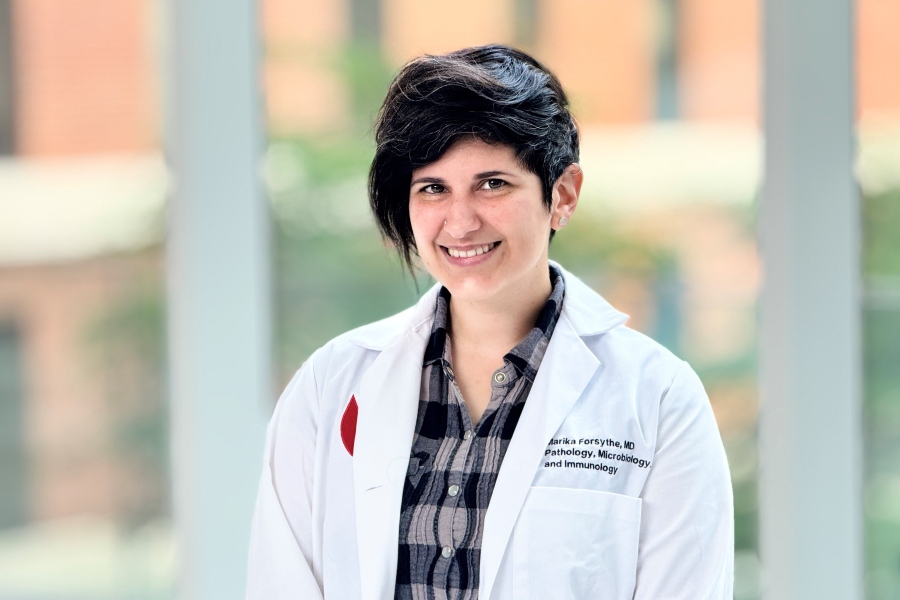
A pathology fellow is researching pituitary neuroendocrine tumors (PitNETs) in an effort to pinpoint what makes some recur or even metastasize.
Marika Forsythe, MD, a molecular genetic pathology fellow in UNMC’s Department of Pathology, Microbiology and Immunology, explained that pituitary neuroendocrine tumors (PitNETs) are common intracranial tumors. Most of them are benign and can be managed effectively with medication or resection followed by radiation (if needed), but little is known regarding the clinicopathologic features associated with those that recur/metastasize. There is no consensus on the treatment of these cases, either.
“The project is looking specifically at whether there are any molecular mutations or some sort of commonality between the patients who have the tumors that recur or metastasize,” she said. The project’s research team first retrospectively reviewed all the PitNETs diagnosed at UNMC in the past 45 years, identifying 782 PitNETs from 699 patients. Among them, 39 patients (or 5.6%) suffered from tumor recurrences, with two cases even metastasizing (one corticotroph tumor and one atypical lactotroph tumor).
Their work so far suggests that advanced molecular testing, including next-generation sequencing (NGS), may assist with predicting clinical behavior and provide potential targeted therapy. Currently, NGS has been performed on three aggressive cases. From the two metastatic cases, analysis revealed a potentially targetable MET mutation in the corticotroph and CDKN2A copy number loss in the lactotroph, among numerous other alterations. The third case, a recurrent corticotroph, revealed mutations in ATRX and TP53, amplification of FGF23 and FGF6, and a splice variant inthe AR gene. This tumor was later treated with temozolomide-based regimens and showed a significant decrease in T2 intensity on surveillance MRI scans in the first few months. This suggests effectiveness as a potential treatment option for aggressive PitNETs.
Dr. Forsythe’s study is made possible by the department’s Research Grant Awards, created in 2024. The awards provide up to $10,000 in research funding to residents and fellows. This program aims to advance the experience and mentorship in clinical and translational research.
The Canadian native earned both a bachelor’s and master’s degree in science at Dalhousie University and later got her medical degree from Saba University in the Caribbean. Before coming to UNMC, she completed the University of Chicago (NorthShore) residency program in AP/CP and will be traveling to Emory University for a two-year fellowship in neuropathology following her training here.
Finding the cases was the initial step. “Now we’re trying to better characterize them. Most cases did not have molecular analysis performed on them. That’s the next step. We’ve been trying to pull blocks from the original specimens and the recurrences to first perform IHC staining. Then, we can determine their subtypes and if they demonstrate any aggressive features,” she explained. “And also, we’d like to run molecular testing on, ideally, the most aggressive tumors of different subtypes to determine if there’s any commonality between them. When we get enough cases together, we can start running the actual molecular analysis, which will be interesting.”
Others working on the project include her faculty mentor, Dr. Allison Cushman-Vokoun, Henry F. Krous Professor of Pathology, director of Diagnostic Molecular Pathology and Human Genetics and the Molecular Genetic Pathology fellowship program; Dr. Sahara Cathcart, an assistant professor in the department and associate director of the Laboratory Genetics and Genomics fellowship program; Dr. Jie Chen, an assistant professor in the department; Dr. Thomas Auen, chief resident, and two other residents, Drs. Lili Guo and Jacqueline Peck.
Dr. Cushman-Vokoun is excited that Marika was able to find a project that fits her career path. “Marika will be a fellow in neuropathology next year, so we wanted to find a project that enhances her knowledge base in that area, while also learning molecular principles,” she said. “We hope that the findings will allow for an accepted abstract at the Association of Molecular Pathology Annual Meeting in November and ultimately, a publication.”