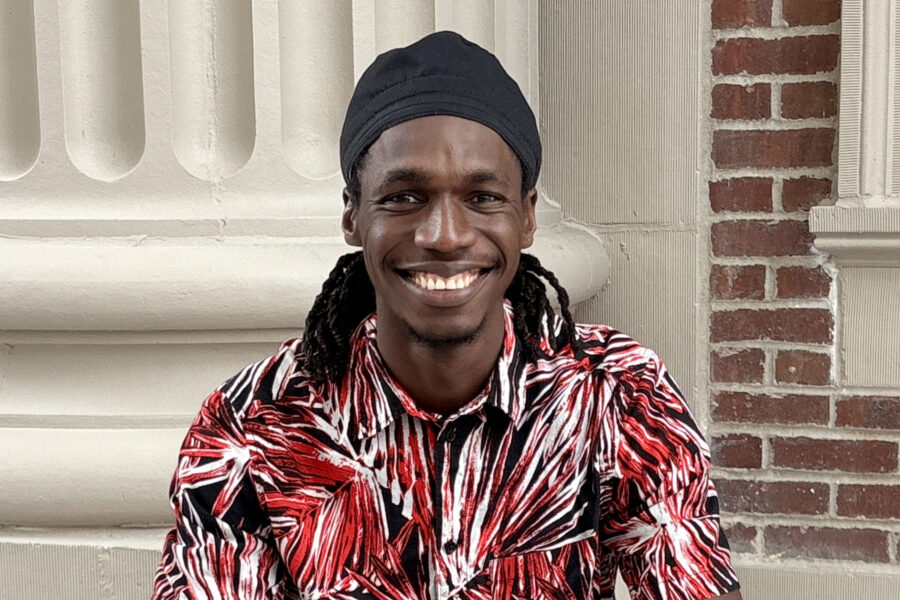
Third-year medical student Omar Ceesay doesn’t like taking his car in for repairs.
“As someone without mechanical training, I often feel out of control when I am in a mechanic’s shop,” he said. “It made me realize that the same loss of control is likely what patients feel about their own ‘body repairs’ when they enter hospitals as non-experts.”
That realization led Ceesay to create innovative ways of communicating medical information through Instagram reels. One of his videos, which has garnered more than 3.4 million views, features him, as a medical student, speaking with his “twin,” himself in everyday clothes, explaining topics such as antibiotic resistance and medication compliance in understandable terms.
“If lies outcompete truth in the public mind, the failure is not only theirs for believing, but ours for not being believed,” Ceesay said. “We must confront where we, as experts, lost people’s trust.
“We sometimes lose the public’s trust to pseudoscientists online because we unintentionally overcomplicate things. And people are more inclined to believe lies they understand over truths that they don’t.”
Ceesay’s work in public communication, including social media education, community outreach and writing on global health issues, led to his being selected for the prestigious Global Health Media Fellowship from the Stanford Center for Innovation in Global Health. He was the only fellow selected for this year’s cohort.
See the Stanford announcement.
In the 2026-27 academic year, Ceesay will spend a semester in Stanford’s acclaimed journalism program, then move to a semester-long internship at CNN to work with the health reporting team of renowned neurosurgeon Sanjay Gupta, MD, before returning to UNMC to finish medical school.
The fellowship teaches the fundamentals of journalism, communications and global health reporting on a variety of media platforms.
Ceesay sees the fellowship as an opportunity to learn more about global health issues and to understand how to communicate them to the broader public.
“You enter medicine knowing how to speak like a regular person, and within a few years, you’re being tested on how to talk to patients without jargon,” he said. “We’re mainly trained to communicate with our peers, not the people we serve.”
Ceesay came to medicine in the wake of a family tragedy. When he was eleven, his father was hit by a drunk driver and died after what Ceesay called “a salvageable brain injury,” because there weren’t any neurosurgeons in The Gambia at the time.
“I was not interested in school at the time. I was only focused on becoming a professional soccer player,” he said. “But when that happened, I remember asking my mom, ‘Why did he pass away?’ She said: ‘Because there was nobody to operate on him.’
“And I’m thinking, ‘Well, I should do that.’” And although his opportunity to come to the United States came through a collegiate soccer scholarship, he found his way to medicine.
Ceesay believes the role of physicians is evolving beyond gatekeepers of knowledge to include interpreters and guides who help patients make sense of complex information and build trust in an increasingly data-rich world shaped by misinformation.
“How you show that you care is by listening to patients and communicating in a way they can understand,” he said. “Sometimes we focus too much on, ‘Let me tell you what I know,’ but on the other end, patients don’t care how much you know until they know that you care.”
“We sometimes lose the public’s trust to pseudoscientists online because we unintentionally overcomplicate things. And people are more inclined to believe lies they understand over truths that they don’t.” Very powerful and truthful statement. Proud of you for filling the information gap!!!!
Congratulations, Omar!
The beautiful game…glad you found your way here. Congratulations!
Could not happen to a better person. Congrats Omar!
Congrats Omar!!
This young man is as amazing as his smile!
This is great, Omar. We are proud of you!