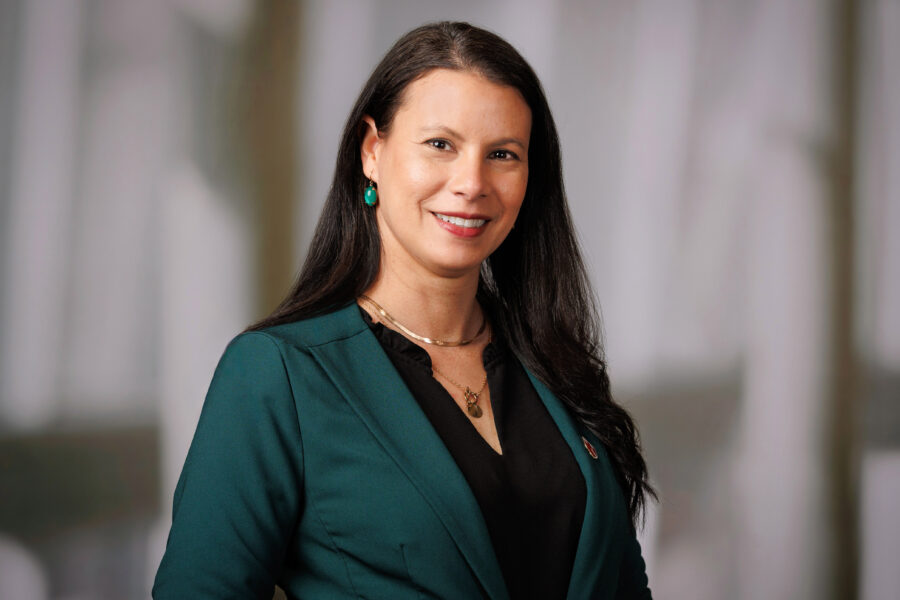
With federal research funding remaining uncertain, UNMC leaders are pursuing new ways to strengthen the institution’s research enterprise, including expanded engagement with industry partners and investments in research infrastructure.
During a May 28 Research Town Hall in the Durham Research Center, Agnes Lenagh, PhD, director of strategic partnerships in the UNMC Office of Industry Engagement, shared updates on the university’s efforts to build industry partnerships that support research growth, innovation and long-term sustainability.
Dr. Lenagh said the UNMC Office of Industry Engagement was created to help researchers navigate opportunities and remove barriers that can slow collaboration.
“When we’re saying that the university is going to be partnership-ready, we’re not talking about controlling those relationships,” Dr. Lenagh said. “We’re talking about removing some of the friction, so that the partnerships can move forward more smoothly.”
The UNMC Office of Industry Engagement works to connect industry needs with expertise and resources across UNMC. In its first five months, the office has facilitated more than 40 company connections, worked with 31 faculty members and supported a range of partnership agreements and collaborations. Those interactions have ranged from workforce development discussions and clinical research opportunities to early-stage validation projects involving basic and translational science.
Companies engaging with UNMC include global pharmaceutical and diagnostic companies.
Several panelists shared examples of how the initiative is helping researchers pursue industry opportunities and connect with resources across campus. Panelists included Rebekah L. Gundry, PhD, FAHA, Stokes-Shackleford Professor of Physiology, chair of the UNMC Department of Cellular and Integrative Physiology, director of the UNMC Center for Heart and Vascular Research and scientific director of the UNMC Mass Spectrometry Core; Michael Dixon, PhD, president and CEO of UNeMed; Jill Poole, MD, chief of the UNMC Division of Allergy and Immunology and professor in the UNMC Division of Allergy and Immunology; and Andy Schnaubelt, PhD, quality assurance and regulatory strategy specialist in the Office of the Vice Chancellor for Research.
Dr. Gundry described how the Office of Industry Engagement has helped support conversations with industry partners interested in technologies developed at UNMC.
“Having a partner in this who understands all the things that we do, the data we deliver, the tools that we have, and then how could industry be interested, that is really helpful,” Dr. Gundry said.
Dr. Poole shared how the office helped her pursue a funding opportunity related to advancing a potential therapeutic toward clinical application. She said the office provided guidance on regulatory and industry-focused requirements that otherwise would have been difficult to navigate.
“Without their assistance, I could not have even tried to apply for” the opportunity, Dr. Poole said.
As the initiative continues to grow, the office also announced plans to establish a Faculty Council for Industry Engagement. The council will help identify faculty-facing barriers, shape engagement strategies and provide guidance as industry partnerships continue to expand.
“We’re looking for faculty who can think beyond individual projects, that can come bring a systems-level perspective and really want to shape how industry engagement evolves here on campus,” Dr. Lenagh said.
Ken Bayles, PhD, UNMC vice chancellor for research, said industry engagement is part of a broader effort to strengthen UNMC’s research enterprise and ensure the institution remains positioned for long-term growth.
One example is an effort to expand Good Laboratory Practice, or GLP, capabilities within UNMC core facilities and research operations. Such capabilities are commonly expected by industry partners and could help make UNMC a more attractive destination for industry-sponsored research while strengthening resources used by investigators across campus.
“I’ve heard GLP is hard,” Dr. Bayles said. “And when I hear something is hard, that tells me, ‘OK, there’s an opportunity there.'”
Dr. Bayles said making core facilities more attractive to industry partners could help generate additional support for research infrastructure while reducing reliance on any single funding source. Efforts such as industry engagement and expanded GLP capabilities, he said, are intended to strengthen the infrastructure that supports researchers across campus while positioning UNMC for continued growth and new opportunities for collaboration.