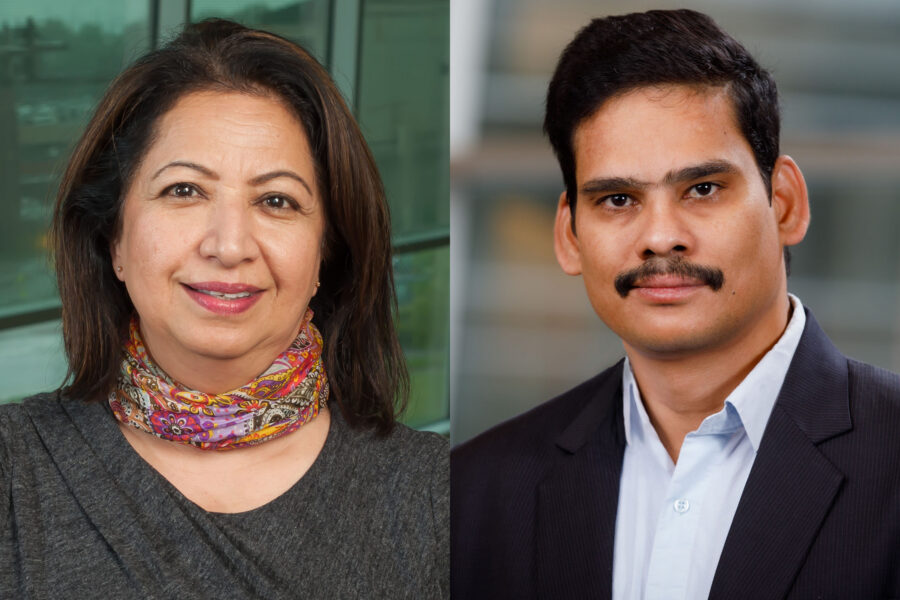
Two UNMC scientists are leading a five-year, $2.8 million R01 grant from the National Institutes of Health’s National Institute on Drug Abuse. Shilpa Buch, PhD, serves as the contact principal investigator, and Palsamy Periyasamy, PhD, serves as a multiple principal investigator on the grant.
The team proposes to study neuroinflammation in people living with HIV who are treated with combined antiretroviral therapy while also indulging in substances of abuse such as cocaine. They also will examine the efficacy of a novel brain penetrant, small molecule C381, in mitigating this neuroinflammation.
cART has been a game-changer in the treatment of HIV. These drugs suppress virus replication, keeping it at undetectable levels in the blood. This has helped turn what was the leading cause of death for all Americans ages 25-44 in 1994 into “a manageable condition, like diabetes, with people living longer lives,” said Dr. Buch, professor in the UNMC Department of Pharmacology and Experimental Neuroscience.
While the blood viral levels are controlled with cART, there is evidence that low-level virus replication persists in the brain, leading to the development of HIV-related cognitive disorders termed NeuroHIV. As people living with HIV continue to age, the brain becomes a target for co-operative effects of residual viral proteins and life-long dependency on cART, as well as misused substances, including cocaine, ultimately culminating in neuroinflammation and ensuing cognitive decline.
One process under investigation in the context of neuroinflammation will be ferritinophagy — a lysosome-dependent pathway that regulates iron homeostasis in the cell. Lysosomes are cellular organelles that break down and repurpose waste and damaged proteins within cells. When the iron pathway becomes dysregulated, as is the case in NeuroHIV, excess iron accumulates in the brain, in turn, contributing to oxidative stress, inflammation and cellular injury. Synergistic effects of residual HIV, long-term cART exposure and substance use disrupt lysosomal function and lead to neuroinflammation, one of the hallmark features of NeuroHIV.
Dr. Periyasamy, associate professor of pharmacology and experimental neuroscience, is investigating whether this damaging process can be interrupted by therapeutic intervention. His preliminary studies have identified a small molecule, C381, that can restore lysosomal functioning — a critical process that allows lysosomes to properly break down and recycle damaged cellular material.
Dr. Periyasamy’s work suggests that restoring lysosomal activity with C381 could help reduce HIV-, cART- and cocaine-mediated neuroinflammation, thereby reversing the cognitive decline in NeuroHIV.
The team will leverage the grant to test these ideas in cell culture and also experimental models, with the long-term goal of developing new therapeutic strategies to reduce neuroinflammation and improve brain health in people living with HIV. Both Drs. Buch and Periyasamy acknowledge their team as the backbone of this work.
Hearty congratulations on my behalf Dr.Palsamy Periyasamy. This is a great milestone in your research journey. Wishing you all the best for your future success.
Thanks a lot, Malar!
Congrates My dear friend,
My best wishes for the success of your work.
Regards
E. Justin dhinaharan
Thanks a lot, Justin!
CONGRATULATIONS !!!! DR. SHILPA BUCH, PH.D., AND
DR. PALASAMY PERIYASAMI, PH.D., FOR YOUR WELL DERERVED RECOGNITION!!!
thanks Dr. Joshi… much appreciated !
Thanks a lot, Dr. Joshi!
Congratulations Drs. Buch and Periyasami
thanks much Imay
Thanks a lot, Imay!
Many congratulations Dr. Buch and Dr. Periyasamy. Great going!
thanks Subhash!
Thanks a lot, Subhash!
Congratulations Dr. Palsamy. Well deserved one. Wishing you All the Best for all your research endeavours.
Thanks a lot Siva!
Congratulations, Dr. Buch and Palsamy!
Congratulations Dr pals on your new research publication ,wishing you continued success and many more achievements.your hard work truly inspiring