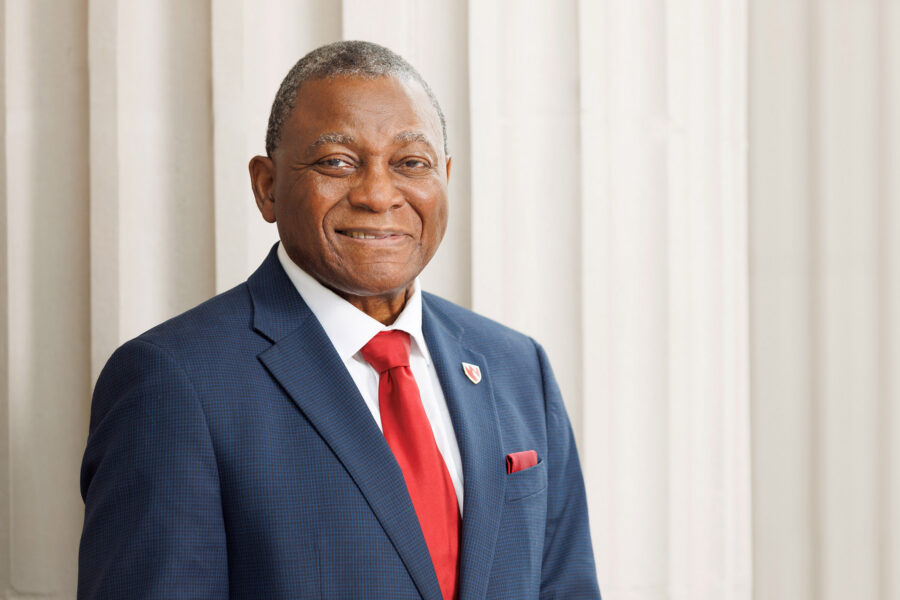
UNMC Chancellor H. Dele Davies, MD, said budget challenges facing the University of Nebraska System must be countered with innovation and growth.
“It’s not sustainable to just keep cutting and remain excellent,” Dr. Davies told a hybrid audience at Tuesday’s all-campus forum. “We’ll continue to advocate strongly for resources,” but UNMC must also rethink existing processes with the goal of becoming more efficient and effective as well as build opportunities for alternative new sources of revenue aligned with our mission.
In discussing the budget, Dr. Davies was joined by Anne Barnes, University of Nebraska senior vice president for finance and UNMC vice chancellor for business, finance and business development; and Susan Kraft Mann, UNMC’s associate vice chancellor for business and finance and director of budget and fiscal analysis.
Barnes said the University of Nebraska Board of Regents today (Aug. 13) will consider the 2027-29 biennial budget requests for the university system and the Nebraska College of Technical Agriculture. To keep pace with rising costs, Barnes said, the regents will consider an inflation-based 4.25% increase to the base budgets of both the NU System and NCTA for each year of the biennium. The university’s request is based on a multi-year rolling average of the Consumer Price Index, she said.
The regents, she said, also will consider requests to fund several initiatives including:
- $5 million in the first year of the biennium to restore previous cuts to state biomedical research support; and
- $25 million in the first year of the biennium and $30 million in the second year to update the Enterprise Resource Planning system used by both the university and the Nebraska State College System. The platform is used to manage a range of services including finance and accounting, facilities management, student services, payroll, procurement and more. The current system on-premises software is being phased out.
Kraft Mann credited last year’s proactive budget-reducing decisions – combined with the approved tuition increases for the 2026-27 academic year – for enabling UNMC to fund the 3% salary pool increase and corresponding benefits for filled positions this year.
Earlier this summer, however, Nebraska Gov. Jim Pillen directed a 5% reduction in state funding for all state agencies, resulting in the university reducing state-aided expenditures by 5% in 2026-27. For UNMC, that reduction equals $8.93 million.
To meet the requirement, each college and unit has been asked to withhold 5% of its state-appropriated budget for the current fiscal year, Kraft Mann said, adding that these cuts may become permanent in the next biennium.
Dr. Davies emphasized the need to continually educate lawmakers on the university’s return on investment. “We can’t keep doing things the same way and expect different results,” he said. “We will continue to advocate, examine what we could stop doing or combine resources to do, look for opportunities for growth….and plant seeds.”
Already, the campus is training faculty and staff on process improvements via UNMC’s Better Processes Initiative, Kraft Mann said. By late September, UNMC will have trained more than 120 people in Lean Six Sigma methodologies to make work processes more efficient, effective and customer-focused.
In addition, Barnes said the University of Nebraska, with the help of Deloitte Consulting, has launched a systemwide assessment to identify opportunities to strengthen alignment, coordination and long-term effectiveness across the institutions. Deloitte has been meeting with campus leaders to assess and evaluate how university structures, processes and resources support the university’s mission.
Still, Barnes noted, “We may be at a point where we need to evaluate doing less with less.”
In other matters, Dr. Davies:
- Paid tribute to two UNMC “giants” who died recently: Harold M. Maurer, MD, whose vision and leadership as chancellor (1998 to 2014) transformed UNMC’s physical campus and research enterprise; and Don Leuenberger, who served as vice chancellor for business and finance at UNMC (1988 to 2015).
- Noted plans for a joint education/research summit this fall, where individuals from UNL and UNMC will work together to find opportunities for collaboration and discuss what challenges we could face. In addition, the Higher Learning Commission willvisit the UNL and UNMC campuses on Oct. 5-6.
- Acknowledged this summer’s last cohort – and formal ending – of the longstanding national Summer Health Professions Education Program. UNMC has participated in the pathway program since 2006 and hosted more than 1,680 students along the way. Still,Dr. Davies said,UNMC pathway initiatives remain strong and include work through the Office of Health Workforce Initiatives.
- Said UNMC’s government relations team is working with Sen. Robert Dover and the appropriations committee on LR 399, which will examine public appropriations on biomedical research. A hearing is expected this fall.
- Noted, that nationally, the U.S. Senate last week confirmed Erica Schwartz, MD, JD, as director of the Centers for Disease Control and Prevention. A confirmation vote for Sean Kaufman to become Assistant Secretary for Preparedness and Response is expected in September.
Dr. Davies closed the forum by thanking faculty and staff. “I’m very proud of the work that you all do and very proud to represent you,” he said. “I remain incredibly optimistic that we’re going to continue to be excellent…and continue to grow.”