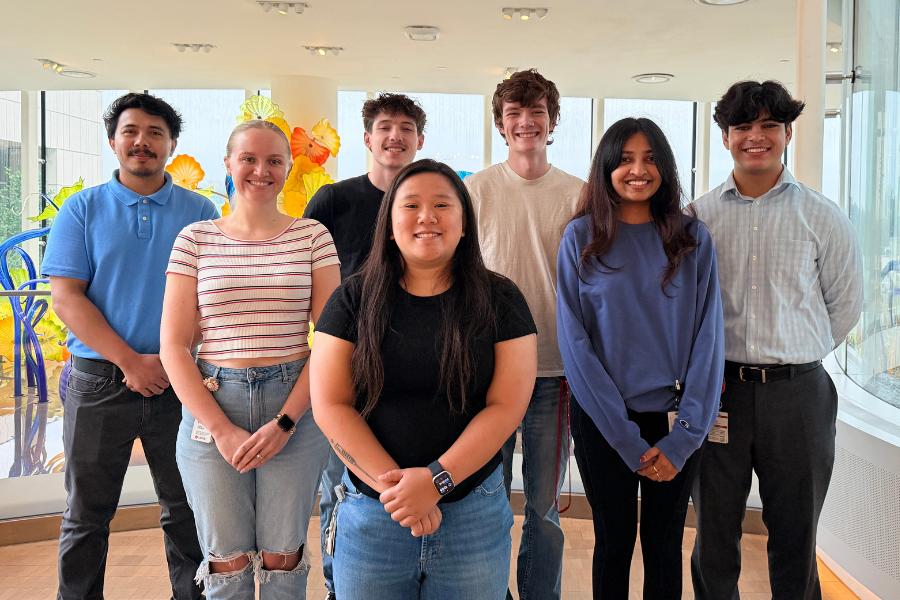
Ten weeks into his summer research with the Summer Undergraduate Research Program (SURP), Abdul Hameed Rahmanzai, a first-year University of Nebraska at Omaha student, came across an unexpected finding—one that prompted him to look more closely at what the data were telling him.
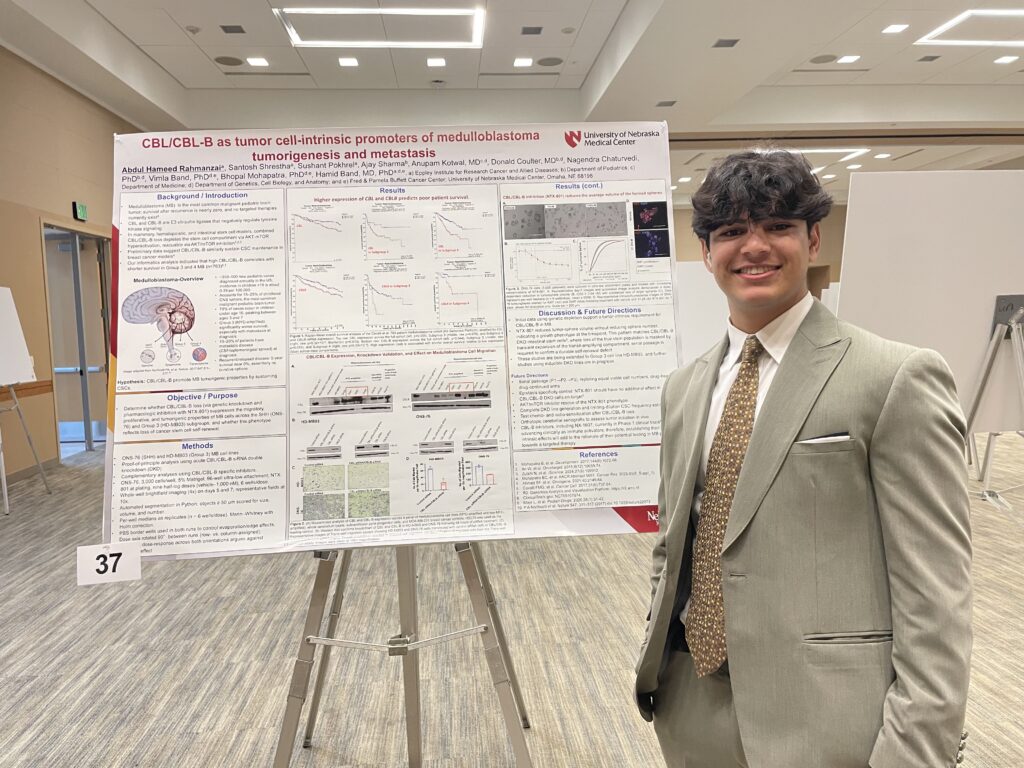
“This summer I learned how to turn a research question into careful work at the lab bench,” Abdul Hameed said, as he described running dose-response tests and closely reviewing the results.
Abdul Hameed spent his summer studying CBL and CBL-B, two proteins that might play a role in the growth and spread of medulloblastoma, the most common malignant brain tumor in children. Because recurring medulloblastoma is hard to treat, there is a need for better treatment options. His project looked at whether blocking CBL and CBL-B could stop these cancer cells from growing and spreading.
Abdul Hameed used patient-derived cell lines to test both genetic knockdown and a small-molecule drug called NTX-801. Early results showed that the drug reduced tumor sphere size in a dose-dependent manner, suggesting that CBL and CBL-B could be promising treatment targets.
However, these results also led to a new question.
“The data contained a nuance that initially might have been easy to overlook: tumor sphere volume dropped, but the number of tumor spheres did not,” Abdul Hameed said. Instead of jumping to a simple conclusion, he thought more about what the results meant. He reasoned that the drug was slowing growth rather than eliminating stem-like cells outright.
“More important than the experiment’s outcome was learning how to handle uncertainty instead of forcing a simple answer. That showed me how real translational science works,” he said. “Scientific discovery often comes not from quick answers, but from asking better questions about unexpected results.”
“The cycle of questioning, testing, interpreting, and rethinking is central to the 10-week Summer Undergraduate Research Program (SURP). The program lets young scientists experience how scientific discoveries happen, from formulating a research question and designing experiments to interpreting data and dealing with unexpected results,” said Associate Director for Training and Education Joyce Solheim, PhD, of the Fred & Pamela Buffett Cancer Center.
Over the past five years, more than 190 SURP students at the University of Nebraska Medical Center have gained firsthand experience in cancer research at the National Cancer Institute-designated Fred & Pamela Buffett Cancer Center. They work with faculty mentors in basic, clinical, and public health-focused research. This summer, Porter Dickenson, Abdul Hameed Rahmanzai, and Joshua Wilkinson were among the students working in cancer-focused labs.
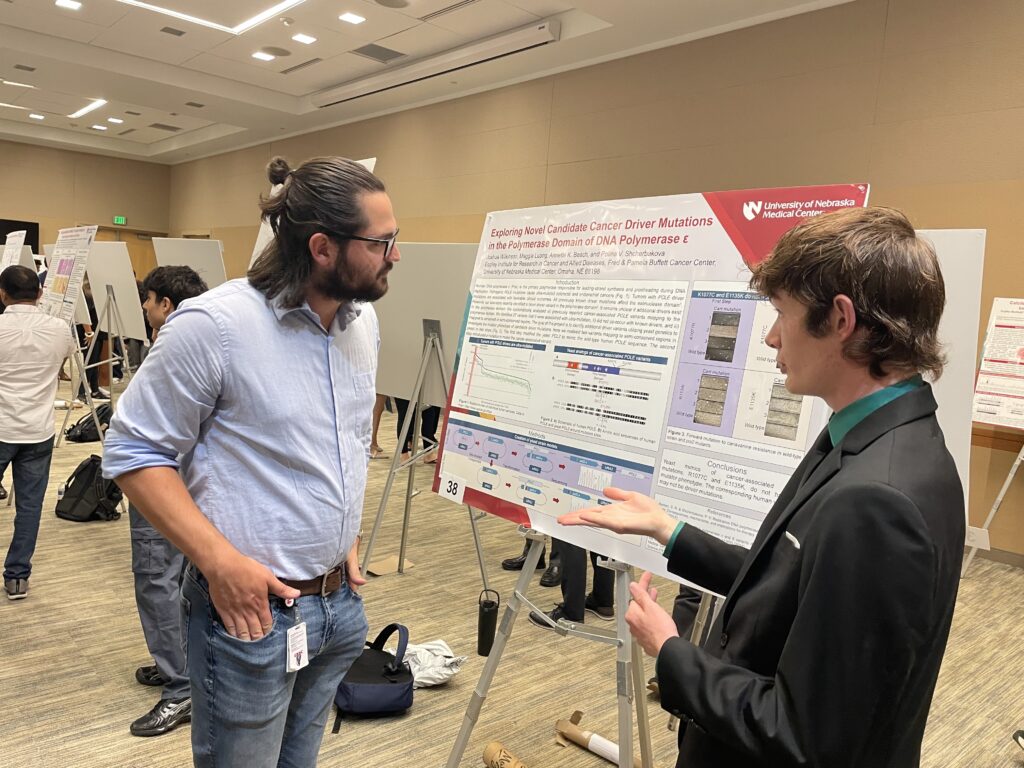
Joshua Wilkinson, a sophomore at Chadron State College, spent the summer studying cancer-related mutations in the polymerase domain of DNA Polymerase ε, a protein that helps copy DNA.
He used yeast genetics in his project to see if certain cancer-related variants could cause an ultra-mutator phenotype. Knowing which variants act as cancer-driving mutations matters because they can influence how tumors grow and, in some cases, are linked to better clinical outcomes.
“The project let me learn new lab techniques while using scientific concepts to an active research question,” Joshua said.
“I learned many new lab techniques that will be very useful in the future,” he said. “These skills will help me continue my science education and improve my ability to do research at a higher level.”
Although each student’s research question is different, all SURP participants get to learn in an active research environment. They work with faculty mentors, graduate students, postdoctoral scientists, and research staff in the lab. This layered mentorship helps students learn from researchers at all career stages and gives them a better idea of what working in science is like.
For students doing cancer-focused research, the lab experience is supported by the Cancer Biology Basics Workshop. Graduate students from the Cancer Research Doctoral and M.S. programs lead this weekly workshop, which is open to undergraduates in the summer programs. The workshop helps students deepen their understanding of cancer biology and connect what they learn in class to their lab research.
“The combination of research, mentorship and educational opportunities gives students more than just laboratory experiences. It offers them an early look at how scientific discovery works and helps them develop the skills they need to succeed in science,” said Dr. Solheim.
For Abdul Hameed, that meant learning that an unexpected result is not necessarily a setback; it can be the beginning of a better question. For Joshua, it meant developing technical skills and applying scientific concepts to an active research problem. For both students, the experience offered a foundation they can carry into the next stage of their scientific careers.
Want to learn more about the Summer Undergraduate Research Program or apply for a future group? Visit the Summer Undergraduate Research Program website for details about the program, who can apply and when.