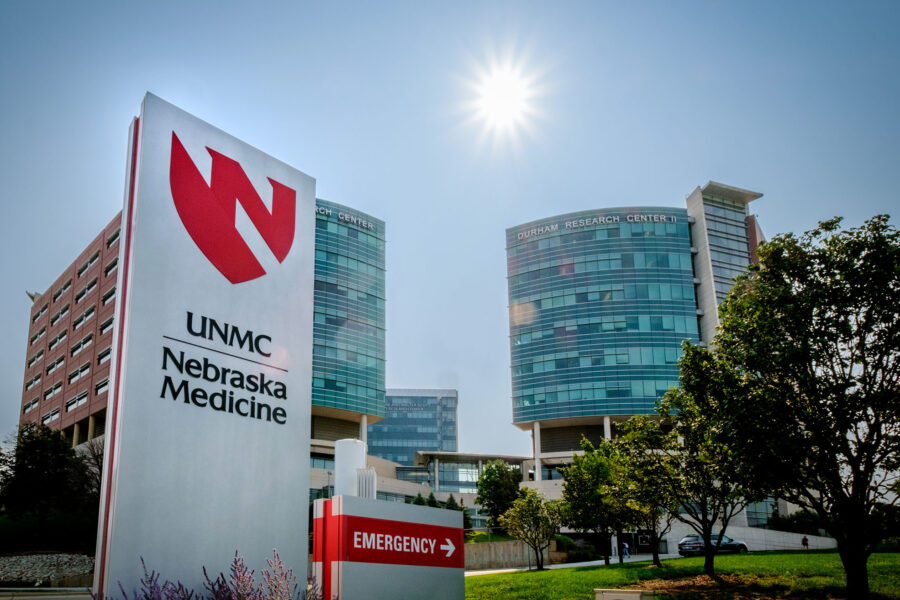
The University of Nebraska Board of Regents took the next step to move toward single-member governance of Nebraska Medicine during a special Board of Regents meeting in Lincoln on Thursday.
During the meeting, the board unanimously approved a proposed transaction that would transition Nebraska Medicine from dual-member governance as Clarkson Regional Health Services (CRHS) withdraws and the University of Nebraska becomes the sole member.
The university and CRHS have shared dual-member governance of Nebraska Medicine since 1997, when its predecessor, the Nebraska Medical Center (TNMC), was formed. The partnership between CRHS and UNMC extends back to the 1950s, when what is now CRHS opened a hospital at 42nd Street and Dewey Avenue in Omaha in order to extend academic opportunities to students and faculty at the medical center.
Since then, said NU President Jeffrey P. Gold, MD, the university and CRHS have been united by a shared vision to provide world-class care to Nebraskans and to provide the highest quality medical education to the next generation of medical professionals.
“This moment gives us the chance to stay true to the vision that has helped Nebraska Medicine grow into a world-class medical center,” Dr. Gold said during the meeting. “It allows us to continue delivering the highest-quality care our patients expect, while strengthening the alignment between Nebraska Medicine’s mission and the academic mission of UNMC. It enables us to carry forward a model that preserves Nebraska Medicine’s long-standing nonprofit structure and the strong governance of a dedicated, effective hospital board. And it allows us to keep governance of Nebraska Medicine with another Nebraska institution – its only public university system.”
When CRHS began exploring withdrawal of membership from Nebraska Medicine, its leadership reached out to the University of Nebraska Board of Regents to ask if the board would acquire CRHS’s stake in Nebraska Medicine and its real estate, a codified transition predetermined in the governing documents. That first conversation, in the summer of 2024, laid the groundwork for Thursday’s vote.
The decision drew support from several faculty members at the University of Nebraska Medical Center who spoke in favor of the measure on Thursday.
Chandra Are, MBBS, a surgical oncologist and the senior associate dean for graduate medicine education at UNMC, said Nebraska’s academic medical center trains more physicians than 94% of the 903 sponsoring institutions in the United States. In large part, he said, that’s because of the strong relationship between UNMC and Nebraska Medicine.
“So here we are deciding the future of one of the best health care systems in Nebraska and America,” he said. “This can happen by maintaining the collaborative spirit between UNMC and Nebraska Medicine.”
Brad Britigan, MD, dean of the UNMC College of Medicine, agreed that the move to sole-member governance could further strengthen the relationship between Nebraska Medicine and UNMC.
“Such single membership could significantly benefit both UNMC and Nebraska Medicine — but most importantly the patients of Nebraska Medicine and the citizens of Nebraska — by enhancing the alignment of the talent and resources of both entities,” said Britigan, who is also an ex officio non-voting member of the Nebraska Medicine Board.
Joann Sweasy, PhD, director of the Fred & Pamela Buffett Cancer Center at UNMC, said that for her, the strength of the partnership between UNMC and Nebraska Medicine was part of what drew her to Nebraska.
“UNMC is what it is because of Nebraska Medicine and vice versa,” she said. “My hope for the future is that this partnership continues to become even stronger.”
Many Nebraskans already see UNMC and Nebraska Medicine as one and the same, said H. Dele Davies, MD, interim chancellor for the University of Nebraska Medical Center. That is no accident. Virtually all the physicians at Nebraska Medicine, including those who treated Gov. Jim Pillen after a fall last year, also are faculty at UNMC, he said. The two entities share a reputation for excellence and vision for the future. It’s difficult to tell where one ends and the other begins.
“We share the same logo, we share the same mission statement, and we share the exact same values,” Dr. Davies said.
Paul Kenney, chairman of the NU Board of Regents, emphasized that the action taken by the board on Thursday does not seek to change operations at Nebraska Medicine. Rather, it seeks to build upon the already strong foundation of collaboration, education and care.
“This decision ensures continuity of the nonprofit status and day-to-day operations at Nebraska Medicine. It aligns us with other leading academic medical centers, both in the Big Ten and across the country. It ensures that Nebraska Medicine continues to be led by Nebraskans whose interests lie in serving our state and its people,” he said. “We look forward to working with all partners in the weeks and months ahead to build on the strength of Nebraska Medicine and ensure a consistent, sustainable future in which we can continue to provide the world-class care that Nebraskans expect and deserve.”