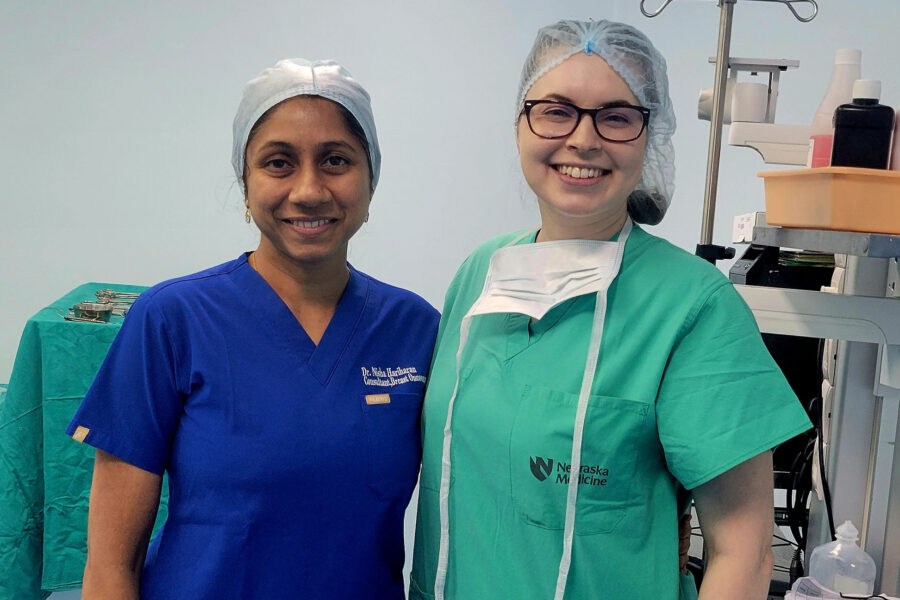
Rachael Newton, MD, a general surgery resident at UNMC, returned this semester from a four-week rotation at the Basavatarakam Indo-American Cancer Hospital and Research Institute, located in Hyderabad, Telangana, India.
The rotation is part of a longstanding collaboration between UNMC and Basavatarakam, one of the premier cancer institutions in India. For Dr. Newton, who is interested in oncology and particularly in breast cancer, the visit allowed her to explore the difference in Basavatarakam’s patient care and relations, cancer screening procedures and treatment programs and the American health care system.
“It’s a different population in another part of the world with a unique culture, so you can see changes in values and approaches from every angle but still working toward the same goal – the appropriate medical care for the patient,” she said.
Under the leadership of Dr. TS. Rao, medical drector, head of surgical oncology and CEO of the hospital, Dr. Newton worked in Basavatarakam’s surgical oncology department, focusing on breast cancer alongside Nisha Hariharan, MD, a breast oncoplastic surgeon.
She also spent time with the radiology departments, observing radiation oncology treatments and attending tumor boards. Not being on a specific rotation, she found that she had time to see different departments, all related to the management of breast cancer, such as reading an MRI in radiology and watching a biopsy in pathology.
“I also learned a lot about their culture and their approach to medicine,” she said.
Dr. Newton pointed to several takeaways from the visit.
“There’s value in seeing how surgeons with different training and educational systems approach a problem. Some of these alternate techniques I might employ in my practice, because the surgeons articulated what experiences led them to adopt certain approaches.
“From a cultural standpoint, it was beneficial to see how patients deal with the diagnosis of cancer in India, what their expectations are, what the physician’s expectations are. My takeaway was that medicine has to be personalized and targeted toward the individual’s personal beliefs.”
Dr. Newton observed more family involvement with patient care at Basavatarakam as patients were accompanied by family members, often a large group.
“They call them ‘attendants,’” she said. “A lot of the updates on the medical care would be directed to the attendants along with the patient. You’re still talking to the patient, obviously, but by having more people around, there are more ears to hear the news, to ask about what the physician is saying and to offer insights. In the U.S., obviously that can be the case; but it seemed more common in India.”
Dr. Newton encouraged other residents to explore the Basavatarakam rotation.
“It really opens your eyes to the art of medicine,” she said. “And it really teaches values that will carry on into anybody’s career, no matter what specialty they go into.”