Artificial intelligence has become an unavoidable topic in academia, and UNMC’s Omaha campus is no exception.
The past several months alone have brought a steady run at UNMC of AI summits, talks and symposia.
While the opportunities to use AI to advance research abound, a harder question is what to actually do with the technology in a classroom.
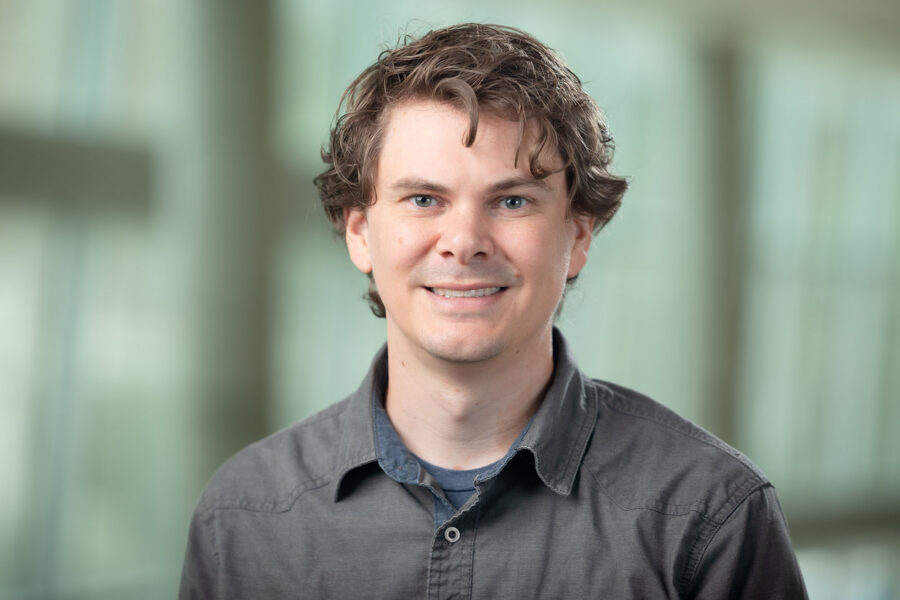
We asked Jordan Rowley, PhD, associate professor of genetics, cell biology and anatomy, scientific director of the Genomics Core Facility and co-director of the Bioinformatics and Systems Biology PhD Program, how he incorporates AI into his graduate teaching.
His approach is built on a single principle: Students should learn to use AI capably and responsibly.
“The instinct to ban AI in the classroom is understandable, but it doesn’t prepare anyone for what is quickly becoming the norm across industries,” Dr. Rowley said. “Students are going to encounter employers that use these tools, and we should make sure that they know how to use them well, that they understand what the tool is doing and can tell when to trust it.”
One simple way Dr. Rowley uses AI is to “flip the classroom.” In one of his classes, students are given a prompt for an AI chatbot that instructs it to act as a learner who knows nothing about the topic. The student then acts as the teacher, explaining the material clearly enough for the “learner” to follow.
“People learn a concept far better when they have to teach it,” Dr. Rowley said. “The key to the exercise is prompting the AI to keep asking probing questions, delving deeper into the topic until the student can no longer answer them. This forces students to put an idea into plain language and identify gaps in their knowledge.”
Students do the exercise individually while Dr. Rowley circulates, then they regroup to compare notes and discuss the main takeaways together.
These discussions often reveal the technology’s limits, which he treats as part of the lesson.
“These tools hallucinate. They produce confident, wrong answers, and students need to see that firsthand,” he said. “Learning to catch the error is a skill requiring human interaction.”
Even as Dr. Rowley is encouraging proper use of the technology, he acknowledges the concerns people have about AI.
“I don’t want to wave away the concerns, because they’re real,” he said. “AI usage carries a real environmental footprint, they were trained on work people never agreed to hand over, and they can reinforce bias in ways that are easy to miss. Part of using a tool responsibly is understanding its costs and being able to weigh them, not just admiring what it can do.”
Dr. Rowley also is bringing AI to his bioinformatics data analysis course, where the technology is genuinely strong and, he notes, increasingly useful for scientific research.
“You have to know why you’re doing each step and how to fix it when something breaks,” he said. “I teach the fundamentals, then I’ll demonstrate ways that AI can automate routine work so that a researcher spends more of their attention on the questions that matter. Directing it well, and catching it when it’s wrong, is the part that takes real skill.”
For Dr. Rowley, that is the whole point: AI treated not as a shortcut or a threat, but as a skill, one his students will need, taught alongside the judgment to use it well.