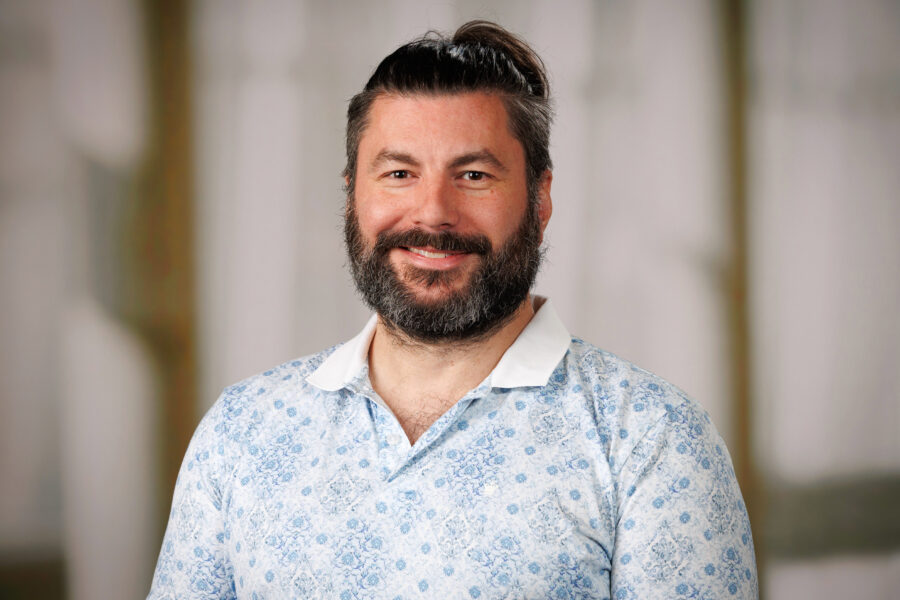
John LaCava, PhD, is a new UNMC Graduate Studies faculty member.
Hometown: I don’t have a hometown in the way people usually use this expression. I moved around a lot my whole life. But I was born in Waltham, Massachusetts.
Title and department at UNMC: Professor, UNMC Department of Biochemistry and Molecular Biology
Research/professional interests:
My research aims to reveal:
- Which biomacromolecules — proteins, RNA and DNA — assemble into functional molecular machines inside cells;
- How those machines contribute to the processes of life; and
- How their interactions and functions change in disease.
To do this, we develop tools within the field of “interactomics.”
Alongside our tool-development efforts, we pursue a variety of biological interests using those tools, including, prominently, the molecular biology of LINE-1 retrotransposons. These are mobile, virus-like “selfish genes” that proliferate within our genomes and, over evolutionary time, have come to compose a substantial portion of our DNA. We study how LINE-1 and other virus-like genetic elements interact with their host cells and the consequences of those interactions in cancer, autoimmunity and diseases associated with aging.
How I fell in love with “Science for the Benefit of Humanity”:
My path into research science began at Massachusetts Bay Community College, where I studied biotechnology and first learned how to work with DNA, proteins and cells in a bona-fide laboratory setting. I soon found that I loved being hands-on in the design and execution of experiments. I am somewhat obsessed with fine details — which, as it happens, often make or break an experiment. My enthusiasm and early aptitude earned me a position as the college’s biotechnology laboratory manager, and, alongside my studies, I took a second job as a semi-synthetic chemist at a local biotechnology company, producing new antibiotics to combat emerging drug resistance.
As a young man from a family of modest means, I was eager to leave where I grew up and experience more of the world. Molecular biology stood out as not only something I loved, but something I was good at — and something that could take me anywhere in the world where answers to biomedical questions were being sought. My success at community college first took me to Edinburgh, Scotland, for a research internship. I then transferred to University of California, Davis, to complete my bachelor’s degree in biotechnology before returning to Edinburgh for my PhD in molecular genetics.
By then, science had become much more than a possible profession: I knew I had found a vocation through which I could express great passion and devotion while pursuing my ambitions and satisfying my appetites for adventure, discovery and continuous growth. Many further adventures in other countries as well as stateside followed, throughout which I have consistently pursued the “Science for the Benefit of Humanity” (which also is the mission statement of my previous employer, The Rockefeller University, in New York City). It’s a pursuit I am excited to continue as a member of the faculty at UNMC.
Education:
- AS, biotechnology, Massachusetts Bay Community College, 1998
- BS, biotechnology (specializing in fermentation science), University of California, Davis, 2000
- PhD, molecular genetics, University of Edinburgh, Scotland, 2005
Memberships:
- RNA Society
- American Society of Biochemistry and Molecular Biology
- Human Proteome Organization
- American Heart Association
- Transposon Society
Three things people may not know about me:
- I worked many years in restaurants before I took up science full-time – I greatly enjoy cooking and it is one way I decompress from stress.
- I have played the drums since I was a teen and was active in several bands during my 20s and 30s. Now I just jam out sometimes for fun.
- For several years, I co-directed a nonprofit international organization that was focused on bringing scientists and artists together in collaborative projects. Although that organization no longer exists, I am still active and enthusiastic about supporting such collaborations when I can – I guess science just keeps me too busy to do it as often as I might.