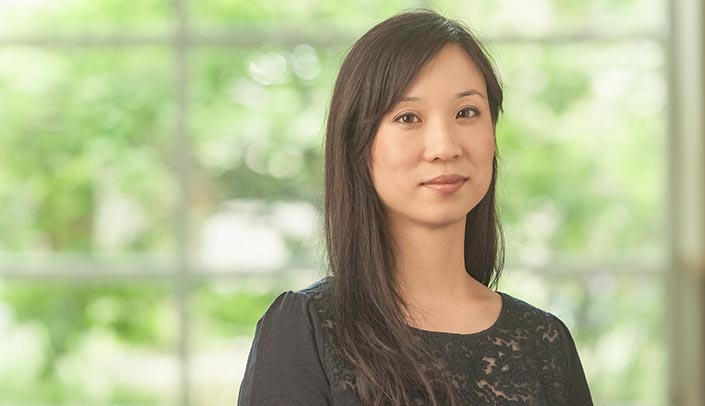
Part of the mission of the Internal Medicine Office of Belonging and Community Engagement is to promote cultural awareness. Its monthly newsletter, Engaged, features an inspirational person who identifies with the culture being celebrated that month.
In recognition of Korean American Heritage Day on January 13, we are talking with Lydia Kang, MD, associate professor in the UNMC Division of General Internal Medicine. A best-selling author, Dr. Kang’s new book, K-Jane, is about a Korean American girl who feels inadequate because she lacks knowledge of the Korean culture. She embarks on a mission to teach herself all about it so she can share her knowledge with her soon-to-be-born baby brother. She records her progress on a vlog which ends up going viral, and the ensuing drama helps her see what it really means to belong.
Can you share a bit about your journey from medicine into writing, and how the two paths intersect in your life?
There had always been an interest in writing and publishing, but I can thank medicine for opening the door. Back in New York City when I was a young attending physician at Bellevue Hospital, I woke up in the middle of the night and wrote an essay on a palliative care patient I had been rounding on. It ended up being published in the Annals of Internal Medicine (“The Veil”) and that encouraged me to join a writing group, the Seven Doctors Project, here on campus over fifteen years ago.
What inspired you to begin writing alongside your medical career?
I was one of those people who was always twiddling around with creative hobbies on the side. Knitting, sewing, and cooking. When I decided to give writing a try, alongside practicing medicine, it felt very different. I took a huge leap of faith that somehow all the learning and writing I was doing would result in something publishable. It was a dream of mine, but for the first time in my life, it felt slightly possible. So, I dug in and tried really hard. They say “write what you know” as advice; writing about patient care was how I got my toe in the door. My imagination sort of took off after that, and I expanded into fiction.
How does your medical background influence your storytelling, especially when writing about science or history?
The fact-checking is always happening in writing fictional scenes. Being in internal medicine keeps me aware and informed on a huge range of medical topics, and that has been quite a blessing. But writing nonfiction is a different beast. You are balancing facts with entertainment. It’s fun, but challenging in its own way.
Also, I always joke that as a doctor, I’m striving to keep my patients happy and alive. In fiction, I’m always murdering characters in the creative ways that only a medical professional can, which is a little gruesome but also hilariously ironic.
What challenges have you faced balancing the demands of medicine with the creative process of writing?
They actually balance each other out in shockingly good ways. Medicine can be emotionally and mentally taxing in a way writing isn’t. With writing books, someone’s life isn’t on the line if you choose a certain plot point. But you also get to create these vast worlds, and characters, and make your readers laugh and cry and escape reality. It’s such an honor to be given that opportunity. And when the publishing world gets stressful (and there is plenty of stress in publishing) it’s incredibly grounding to go to clinic and make a tangible improvement in a single person’s life.
As an internal medicine physician, what does “belonging” mean to you in the medical community? How do you think about Belonging as an author?
The medical community is an ecosystem, and every one of us is a part of that connected web. I feel very much like I’m anchored there, connected to patients, and my team at the DOC, and my colleagues, and the emerging information that is medical science. When a patient needs good care, a string in the web gets plucked like a guitar string, and when the ecosystem is working, you can hear it sing. It works. I love being part of that.
Belonging as an author is a whole other beast. Writing is gig job, so there is this instability always there, but it keeps you sharp and keeps you active. Lots of ups and downs. But I have a community of authors, here in Omaha and out in the world, and we support each other. Some of my best friends are authors, and they really get me. I feel very lucky that way.
What lessons from your writing career have enriched your work in medicine, and vice versa?
I think I am a better listener, partially because writing has honed my listening skills, but honestly age has made me a more patient listener. Medicine always inspires my ideas in books, both in fiction and nonfiction. The first US female physician, Elizabeth Blackwell, had a cameo in my book, The Impossible Girl. The book was also about the horrible history of grave robbery and how it was entwined with medical education. That’s just two examples of many.
Many of your nonfiction works explore the history of medicine and healing. What do you hope readers take away from these explorations?
The history of medicine is rich, and gory, and shocking, and enlightening. But we don’t get to hear so much about it today, and health professionals get almost zero medical history in their training. I like that the books remind us that we are on this continuum to take good care of people and understand how everything works. But it’s important to look back and see our mistakes, which one we thankfully left behind (lobotomies! Eating mercury!) and which ones we still use (leeches.)
Who or what has been the most influential figure in your journey of combining medicine and writing?
My husband, Dr. Yungpo Bernard Su. He has always been my champion and never questioned or doubted my endeavors. Also he makes a heckuva good sourdough loaf, and that comes in handy when I’m on my writing deadlines! The brain needs glucose!
What advice would you give to medical professionals who want to explore creative outlets while maintaining their clinical responsibilities?
Be kind to yourself. Keep your eyes on your own timeline, not others. Be open to feedback and improvement. We as professionals hate hearing that we made a mistake, or didn’t do something as well as we would like. But improving your craft is so worth it. Finding time for it is tricky, but you can squeeze bits here and there if you have a passion for it. A little is more than none. And most of all—have fun. Enjoy it!
How has your identity as both a physician and author shaped your sense of belonging in different communities?
I am a bit of a zebra, having these two jobs. As in, I’m a zebra in both professions. When readers or other authors find out I have another job as a doctor in Nebraska, they look at me like I sprouted a horn. When health professionals find out that I have a writing career, mostly it’s awe and excitement, because first, readers are everywhere, and second, they are so happy to know that you can be creative and have a very science-based career. I am a bit weird. But I am very comfortable being weird. Weird is good.
What role does storytelling play in building empathy and understanding in medicine?
More than people realize. Anyone can sit down, with paper and pen, and ask to write something about a doctor/patient interaction that affected them deeply. Those stories are in all of us, and we are all born storytellers. And they connect us together, reminding us that we’re all trying to get through this thing called life. In medicine, we are gifted with the opportunity, every time we sit down with a patient, to hear a story. That can’t be said with so many professions.
Looking ahead, what projects or goals excite you most—either in medicine or writing?
My goals in medicine have always been humble. I joke that I am a worker bee in the hive, and I am very happy doing that. I did my residency in Primary Care, and Primary Care is where I am most happy and content. I love teaching and I get to do that every week. So, goal unlocked, I guess!
As for writing, I want to keep creating all the books I have in my head, for as long as I can write them down, and for as long as publishers will print my books. Every book is a huge challenge and means the world to me, so it’s really just one foot in front of the other. I’m paving my own yellow brick road and as the architect of this world, I’m having a blast figuring out what’s coming around the next turn.