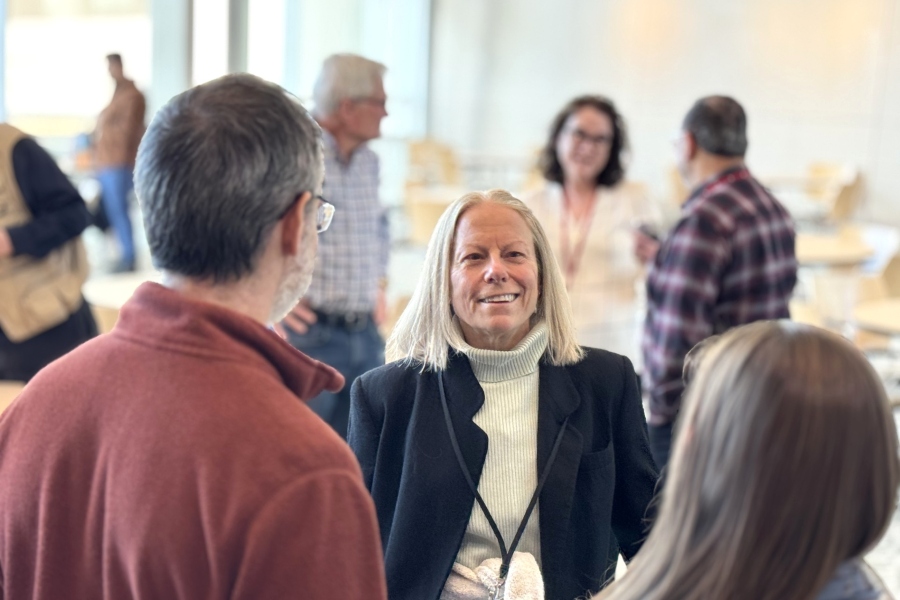
Marilynn Larson absolutely loves scientific research. It’s what got her through a daily commute between Lincoln and Omaha during her 26 years at the University of Nebraska Medical Center. Sometimes sleeping on a cot in her office when she had to get up in the middle of the night for timed experiments, putting on all the protective gear to work in the Biosafety Level 3 Core Facility.
“I love, I love the research part. I love the challenge. I love doing infectious disease research, I like doing cutting edge. The resources here are outstanding,” she said. “But the people here—I think that’s why I love working here the most. Just a lot of good people, a lot of colleagues that are very dear friends that I felt I could go talk to and ask questions. Even though I was kind of all alone in my field.”
That field being select agent pathogens, specifically Francisella tularensis, a hypervirulent Tier 1 select agent that is fatal if not promptly treated. In her time at UNMC, Dr. Larson was lead author or co-author on numerous papers on Francisella tularensis, said Dr. Paul Fey, a professor and vice-chair of research for the department. “Some really great work, so many great things you’ve done here,” he said at Dr. Larson’s retirement reception on Jan. 29.
Dr. Pete Iwen, a department professor and director of the Nebraska Public Health Laboratory, said she is internationally recognized as an authority on the hypervirulent Tier 1 select agent. For all her many contributions to the field, “Thank you, Marilynn,” he said.
Dr. Larson said she is proud of her work as laboratory director for the BSL-3 core facility. She helped get it set up in 2020 and oversaw the associated record keeping/documentation and personnel training at the beginning of the COVID-19 pandemic for UNMC researchers to study this highly infectious virus. She also assisted with the recent upgrades to the facility.
She also developed a more accurate identification method for Francisella tularensis. “The CDC’s assay for Francisella tularensis wasn’t specific enough—there’s a near neighbor strain that isn’t pathogenic, it’s more opportunistic, so their assay wouldn’t differentiate between them. So I published it, I also got a patent for it, but I’m not going to continue the patent because I’m not rich enough to continue a patent, and I want people to use it. But I think the CDC has incorporated that into their new assay so it can differentiate the different subtypes of Francisella tularensis, the different pathogenicity, with one being the one of the most pathogenic bacteria known.”
Dr. Larson also served on the faculty of the UNMC Immunology, Pathology and Infectious Disease (IPID) Graduate Program, and as a fellow in the National Strategic Research Institute of Nebraska. She provided guidance on select agent procedures and regulatory compliance matters required by the Centers for Disease Control and Prevention and assisted with biological select agent and toxin associated projects for the Department of Defense. She is a member of the High Containment Working Group and Biosafety and Incident Command Committee.
Her scientific journey began at the University of Nebraska–Lincoln, where she changed majors a few times before getting a BS in general sciences. “I was fascinated by the sciences—it didn’t matter what it was: astronomy, organic chemistry, physics, I was just fascinated.” She then worked in private industry but found it boring and headed back to school, earning her MS in molecular biology from the University of Nebraska at Omaha and later, her PhD in biological sciences at UNL.
“After that, I was offered a fellowship in virology in Lincoln. But instead I chose a job here because I wanted to do biomedical research with Dr. Tom McDonald in immunology.”
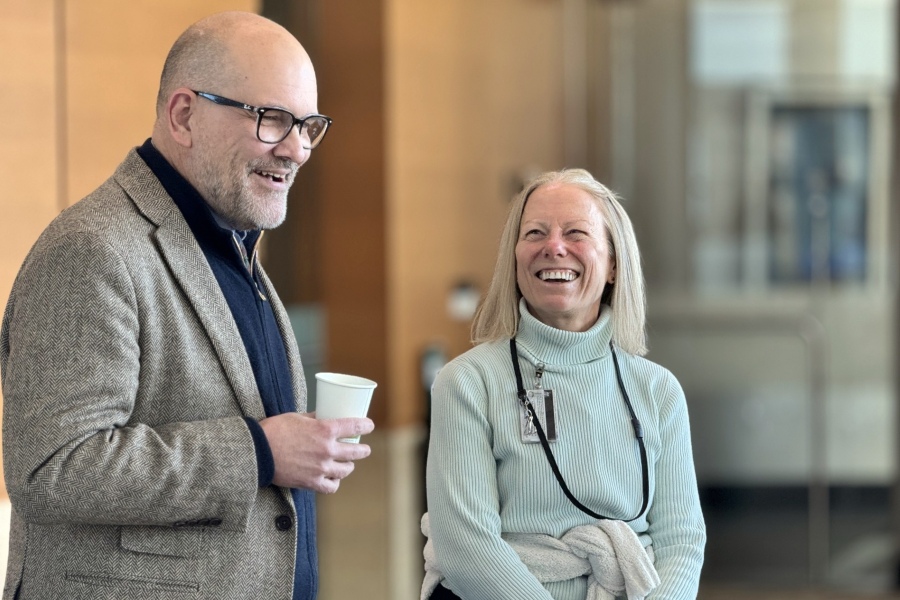
She started at UNMC in 2000 as a postdoctoral student, then joined the faculty a year later as an instructor. She said Dr. Fey mentioned that Dr. Steven Hinrichs, who went on to become the department chair, needed help with his research. “It was a great experience,” she said. “He’s a great mentor. He did a lot of work with biological select agents and toxins. That’s where I got all that experience working with BSL-3 select agents. We did a lot of projects for the DOD. He mentored me to make me more independent. He taught me all this financial stuff. That was like a black hole for me at first.” She was promoted to assistant professor in 2007.
“Pete Iwen has been an awesome mentor, too,” she said. “He kind of pushed me toward Francisella tularensis, because they get a lot of cases of tularemia here in the Midwest. It’s one of the most pathogenic bacteria known, and we have the most pathogenic subtype here in the Midwest. It’s pretty nasty,” requiring research in the BSL-3, wearing PPE. “You have to wear a gown, shoe covers, double gloves, respiratory protection. It’s quite cumbersome and it’s time-consuming. I’d say working with a select agent probably takes you 10 times longer than working with something like staph or E. coli,” she said.
“It’s very slow. I’m not really a patient person, so why I went into research, I don’t know. I think I like the challenge; I like the troubleshooting. I like trying to figure things out.”
Despite the challenges and frustrations, Dr. Larson said she wouldn’t change a thing—besides the hassle of commuting. “I don’t regret it, because it’s been the best thing ever for me. I didn’t know if I would ever find a job I would like after all those other jobs and situations, but I’ve just loved working here. It’s been a great, great time. When you reach a certain age, people keep asking when are you going to retire, when are you going to retire? Because they don’t like their job. And I’m thinking man, I’ve been so blessed. I love my job, I don’t want to retire. But yet you slow down. I lost my oldest brother last year to cancer and I wanted to go see him, but I didn’t. You can’t put that stuff off. It puts it in perspective. I want to spend more time with family and friends before they’re gone, or I’m gone.”
Dr. Larson plans to volunteer with the Boys and Girls Club of Lincoln-Lancaster County. “I’ll try to get these junior high kids and high school kids interested in science,” she said, and do other volunteer work that she didn’t have time for before. She’s also looking forward to exercising more regularly and having more time to garden and make art.
But first, a road trip with her significant other, Richard Conrad, a retired Lincoln high school teacher. “We’re going to head west, go up the coast, take Highway 101 and pick up Richard’s brother and girlfriend and bring them back for Richard’s 94-year-old mother’s birthday.”
This kind of driving she doesn’t mind. “We’ll get to stop whenever we want. If there’s traffic and we don’t want to deal with it, we’ll just pull over someplace interesting and check it out.”