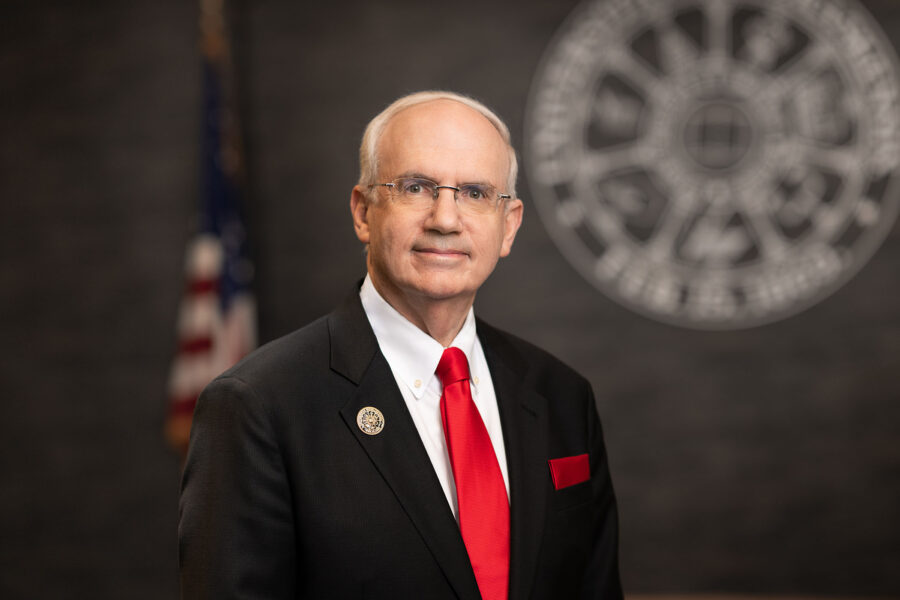
University of Nebraska President Jeffrey P. Gold, MD, and University of Nebraska Medical Center College of Medicine Dean Bradley Britigan, MD, attended a March 5 news conference announcing the U.S. Department of Health and Human Services’ new pilot program expanding nutrition education in medical school curricula.
Secretary of Health and Human Services Robert F. Kennedy Jr. led the event, announcing that medical schools across the country had committed to providing at least 40 hours of nutrition education as part of their medical school curricula.
Expanding nutrition education is an effort that has been underway at UNMC for several years.
Dr. Gold was a featured speaker at the event, which also included Secretary of Education Linda McMahon; Bobby Mukkumala, MD, president of the American Medical Association; David Skorton, MD, president of the Association of American Medical Colleges; and Robert Cain, DO, president of the American Association of College of Osteopathic Medicine.
See a list of participating institutions.
Speaking at the event, Dr. Gold said:
“Much of our health is a gift from our parents. That is the genetic code that we carry, which may create risk, predisposition or even some outcomes, but the environment and lifestyle personal decisions frequently determine the timing, the severity and the total outcome of what that may be.
“The team-based system of physicians, nurses, pharmacists, therapists and so many others work hand in hand with our patients and their families and the communities and not just our medical schools, but our undergraduate colleges, our K-through-12 systems, our early childhood programs together to focus on health and wellness.”
See HHS information on the event.
Prior to the event, Dr. Gold said that education on healthy living, as well as disease prevention and treatment, is a critical component of physician training and necessitates an understanding of the role of nutrition in these areas.
“We are excited to participate in the effort to bring new focus to evidence-based nutrition education in medical school curricula,” Dr. Gold said. “This is an area the University of Nebraska Medical Center has been strengthening for a number of years, through the work of a dedicated team, established by the University of Nebraska Medical Center College of Medicine and our six other health professions colleges. Together these colleges have been working to expand the research and application of nutrition concepts across all phases of the medical curriculum.”
Geoffrey Talmon, MD, senior associate dean of medical education at UNMC, said the effort to expand nutrition education in the UNMC College of Medicine’s curriculum began in 2019 and was initiated at the request of medical students, and that a task force continues to explore ways to build the curriculum.
“The task force has done an incredible job of organically incorporating this material,” Dr. Talmon said. “We’re definitely ahead of the curve compared to peer institutions on this issue, and the number of hours outlined in the initiative is in line with the goals we had set for ourselves.”
The college’s curriculum committee will continue to oversee the nutrition curriculum expansion and approve what, when and how things are taught, Dr. Talmon said.