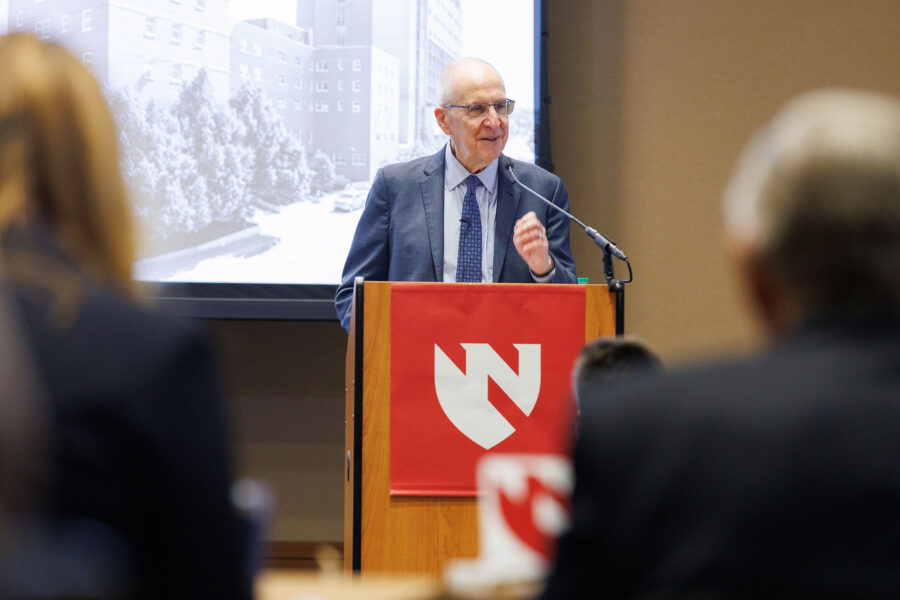
David Skorton, MD, president and CEO of the Association of American of Medical Colleges, delivered the UNMC College of Medicine Alumni Council’s 36th John S. Latta Lecture at UNMC on Thursday, April 9, focusing his discussion on a message of hope and determination in “a time of immense, immense change.”
In 1949, Dr. Skorton said, “at least one form of congenital heart disease saw about a 20% chance of making it to adulthood. And now, there’s a 90% chance of making it to adulthood. That’s a complete reversal of prognosis.”
But despite such dramatic medical advances, he pinpointed four areas of challenge for public health and academic medicine in the current environment, discussing how the AAMC and its member institutions were attempting to grapple with each through the lens of resilience, with optimism and hope and, ultimately, progress.
They were:
Workforce issues and their impact on rural health.
Dr. Skorton saw positive signs on this undeniable issue, including federal efforts to expand residency positions and, through advocacy efforts by AAMC and institutions like UNMC, to collaborate with states and localities on their specific workforce challenges.
“Last fall, the federal government’s Centers for Medicare and Medicaid Services added 400 Medicare-support graduate school, education, residency slots. This expanded health care access nationwide and will have a small but positive impact on both rural and urban communities.”
Legislation that substantially changes the student loan landscape and its possible impact on student access to medical and health programs.
“Every aspiring physician deserves a fair chance at a medical education, no matter their economic background,” Dr. Skorton said.
Eliminating or restricting programs like the Grad PLUS program or public service loan forgiveness would not only undermine the future health workforce but make it harder for patients in rural and underserved areas to access care, he said.
He said the AAMC is seeing collective determination to work on this problem at the national level, and continues to advocate for policies that promote medical school access and affordability.
Challenges to research and advancing scientific progress.
Despite the very real challenges that medical schools and health systems are facing, the AAMC continues to advocate for robust federal support for medical research of all types, he said, striking an optimistic note.
“The medical research community has been enthusiastically engaged on this issue, and I’m encouraged and inspired by Congress’s continued demonstration of support of funding for the NIH and medical research,” he said. “We’re not done. We will continue our efforts, with you and our other members, to bolster research funding and make it more creative.”
The fact that academic medical centers provide a disproportionate share of Medicaid and uncompensated or under-compensated care, a potentially unsustainable situation.
“While academic health systems account for just 5% of hospitals nationwide, they account for 29% of Medicaid inpatient days and 33% of hospital uncompensated care costs,” he said.
“To sustain operations and their missions, these institutions must rely on a combination of federal, state, commercial and other funding sources, and Congress continues to consider policies that could further strain hospitals,” he said.
Dr. Skorton closed the lecture with a call to action to move forward with hope and determination, saying early-career health professionals will likely apply fresh thinking to address these and other issues in creative ways.
“Over this past century and a half, we have witnessed breathtaking advancements in science and medicine. Problems that once seemed absolutely unsolvable are now behind us. As we face new challenges and opportunities, we forge ahead.”