Sixteen Americans who were on a cruise ship associated with a hantavirus outbreak have been repatriated to UNMC and Nebraska Medicine.
They arrived in Omaha early Monday on a U.S. Department of State plane from the Canary Islands. Fifteen were “resting now” on Monday morning in the National Quarantine Unit at the Davis Global Center, reported Michael Wadman, MD, Muelleman Chair of Emergency Medicine at UNMC, the unit’s medical director.

The sixteenth, who previously tested positive for Andes Hantavirus, was transported to the Nebraska Biocontainment Unit for monitoring. This individual was “doing well and not showing any symptoms at this time,” as of Monday morning, reported Angela Hewlett, MD, Orr Chair in Health Security and the NBU’s medical director.
Two other individuals, one showing symptoms, were transported to Emory University in Atlanta and its biocontainment unit.
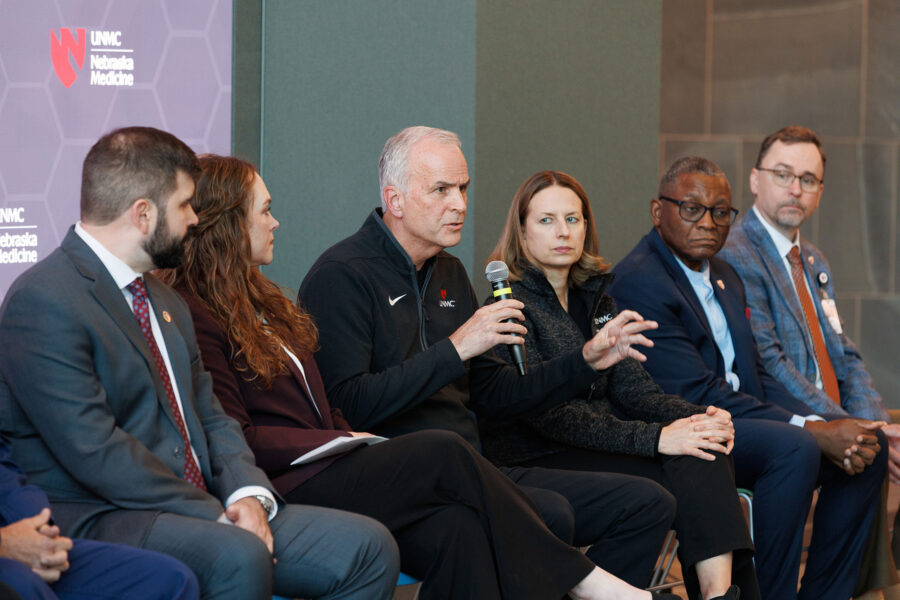
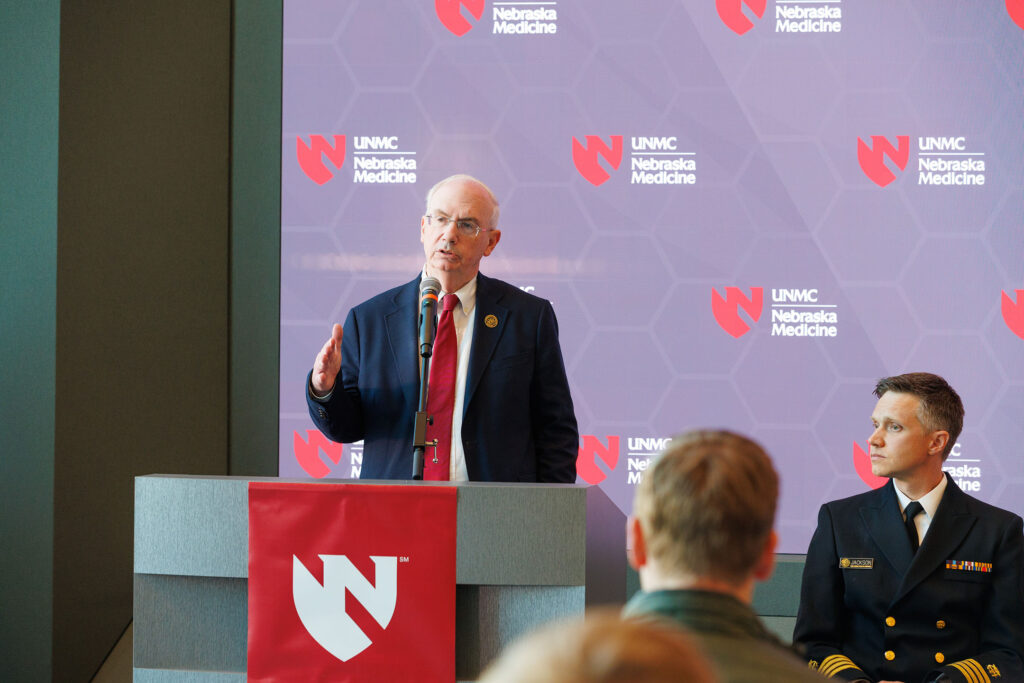
Federal, state, university, UNMC and Nebraska Medicine experts updated the public Monday morning at a press conference at the medical center. CNN, NBC News, CBS News, FOX News, ABC News and KETV News attended, among other outlets.
The U.S. federal government, as it had during infectious diseases outbreaks of Ebola and COVID-19, again turned to UNMC and Nebraska Medicine and its world-class experts and facilities.
“We are honored to have this responsibility to repatriate these American citizens. There is no place in the country where they would be better cared for, more safely and more effectively,” said University of Nebraska System President Jeffrey P. Gold, MD.
The medical center was tapped for this assignment “due to its extensive expertise in handling of special pathogens and because it has the only national quarantine unit in the country,” said John Knox, principal deputy assistant secretary for preparedness and response for the U.S. Health and Human Services’ Administration for Strategic Preparedness and Response (ASPR). Knox was one of a handful of top federal officials on site Monday morning.
“What you are seeing is a system working exactly as intended,” said Matthew Ferreira, DVM, counselor, U.S. Department of Health and Human Services.
The 15 in the National Quarantine Unit are currently “in good shape and in good spirits,” Dr. Wadman said. “They are definitely tired and needed some rest.
“They are all asymptomatic and all very grateful to be here.”
The visiting individuals range in age from late 20s to early 80s, Dr. Wadman said.
Dr. Wadman again compared the NQU facilities to a stay in a hotel room – but with state-of-the-art safety measures and regular health assessments. These individuals will be monitored for 42 days. Whether that is at the medical center or elsewhere remains to be seen. Most people develop symptoms much sooner; six weeks is the virus’s maximum incubation period.
As they interview and monitor the individuals, federal and medical center experts will “have a better idea of when Day One is,” Dr. Hewlett said.
Dr. Hewlett reported that the individual in the biocontainment unit had “a good appetite.” This individual was “very tired, understandably. It’s been a long journey.”
Federal, UNMC and Nebraska Medicine experts again said this Andes Hantavirus spreads through sustained very close contact when people are symptomatic. The individuals at the medical center will be closely monitored for influenza-like symptoms and tested as experts deem necessary.
Once again, cooperation with UNMC and Nebraska Medicine was part of the U.S. federal response, officials said.
“Our response will be grounded in science, grounded in coordination and grounded in transparency,” said Adm. Brian Christine, MD, assistant secretary for health and head of the United States Public Health Service (USPHS).
“The risk of hantavirus to the general public is very low.”
“The rest of America can be assured there is a strong plan in place,” Nebraska Gov. Jim Pillen said.
“We have the best teams, the best policies and procedures, the best training and the experience we’ve had,” Dr. Wadman said.
If he were in these individuals’ shoes, he said, Nebraska is where he would want to be.