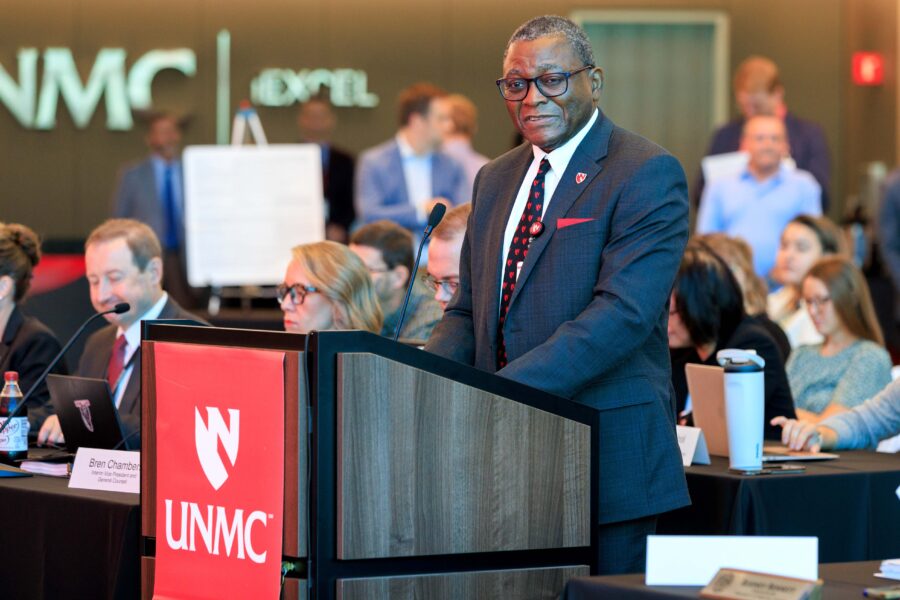
H. Dele Davies, MD, has always wanted to be a difference-maker.
And he points to role models who, during his childhood in Nigeria, set him on a path that led to him being named permanent chancellor of UNMC.
Today (July 1), following his unanimous June 18 appointment by the University of Nebraska Board of Regents, Dr. Davies officially becomes the ninth chancellor of UNMC. He has been serving in an interim capacity since July 2024.
For Dr. Davies, this is his latest and most exciting opportunity to make a difference.
Defining principles in life
His father, a first-generation college graduate, was an attorney, a government official and active church member. Both his parents instilled in their son a passion for service – for making a difference in people’s lives – that stays with Dr. Davies to this day.
“Serving and looking for opportunities to make a difference, that’s one of my defining principles in life,” Dr. Davies said. “My father was generous in the community, and, as an attorney, helped so many people throughout his life. That desire to help, to make a difference, came to me by watching how he made an impact on people.”
An older cousin – “I call him Uncle,” Dr. Davies said – motivated Dr. Davies in his formative years to dream of making an impact on people’s health. The only physician in the family, the cousin treated Dr. Davies when he was struck down by cerebral malaria just after he entered primary school.
“He was the one who treated and cured me,” Dr. Davies recalls. “So that was very dramatic, to see the power of medicine at that young age.”
Although his cousin lived most of his life in Bermuda, where he still resides, he would make a point to visit Dr. Davies and his family when he returned to Nigeria.
“He was a great role model,” Dr. Davies said. “I really connected to him, and we remain close to this day.”
Moving abroad from Nigeria
Herbert Oladele Davies was born in Nigeria. “Dele,” his longtime nickname, is the diminutive of his middle name, which means “Blessings have come home.” The aspiring doctor started his world travels relatively young. At age 15, he left Nigeria to attend primary school in England. He then attended college, medical school and completed a residency in pediatrics in Canada. He took the year following residency to work in private practice, volunteer as a pediatrician in India and backpack across Southeast Asia.
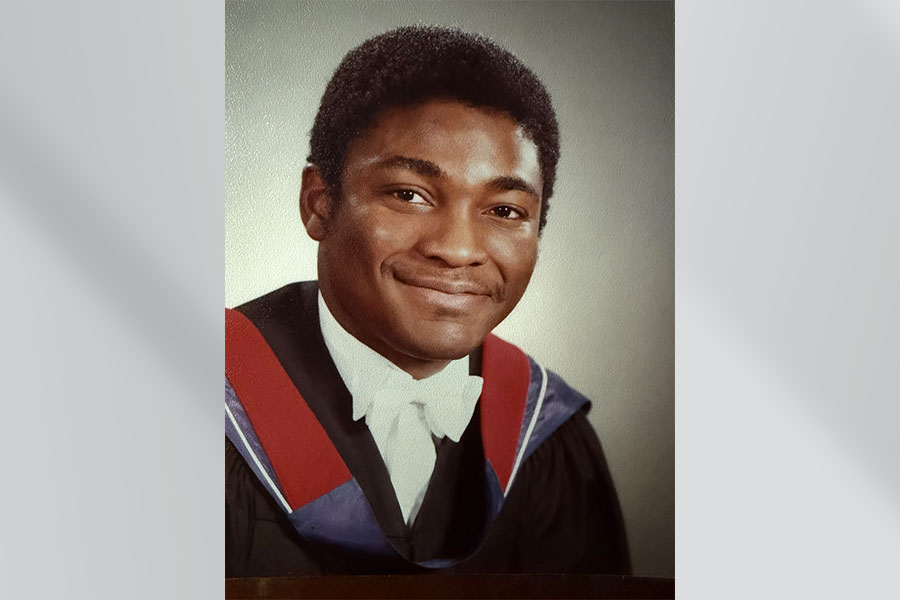
When he returned to Canada, he immersed himself again in training, completing a fellowship in infectious diseases as well as research training in Toronto. After less than a year on faculty in Toronto, he was recruited by Alberta Children’s Hospital at the University of Calgary and spent nine years building his research career, caring for patients, teaching medical students and learning from mentors what it means to be a truly great leader. Dr. Davies then was recruited to the United States to serve as chairman of the department of pediatrics at Michigan State University, where he led for nine years prior to coming to UNMC.
Dr. Davies credits his commitment to lifelong education as a major part of his success.
“My father, as a first-generation university student, instilled in me and his whole family the value of education,” Dr. Davies said. “I saw the opportunities it provided and how people sought him out as a leader because of his education. No matter where I have been in the world, I have witnessed the power of education to transform the trajectory of people’s lives.”
Influencing access to care
It was at Michigan State that Dr. Davies created an initiative that led the community to address what in many ways exemplifies one of his major goals as a physician and educator: access.
“During community focus groups, we found that transportation was a big problem for children, especially children in families that were on Medicaid,” he said. “They were missing more of their appointments than other children. Even children with cancer weren’t getting their cancer treatment on time because they were missing appointments.”
During his time in Lansing, Dr. Davies created the MSU Children’s Health Initiative to address access issues. The foundation and inspiration from this initiative ultimately led one of his friends and former employees to create a nonprofit focused on recruiting volunteers to bring young children or pregnant women and their families to their appointments. Although Dr. Davies already had been recruited to UNMC by the time the nonprofit started, his Lansing colleagues named their organization “The Davies Project” in recognition of his leadership and passion for the mission.
“They’ve now been able to transport thousands of individuals to their appointments, often while also helping to care for other children in the family during the visit,” he said. “That has been transformational for families of the Greater Lansing area. Maybe one child, who may have died of cancer, is now cured and has the potential to become a leader in the community.”
Unique opportunities in leadership
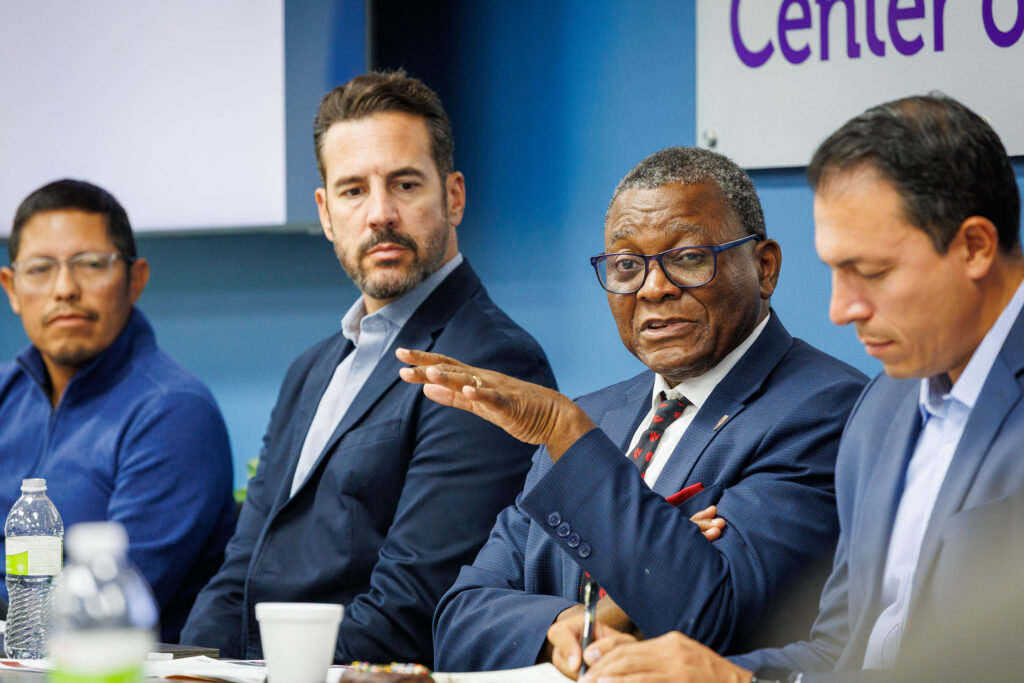
Dr. Davies also recognizes his unique opportunity to transform lives as UNMC’s new chancellor.
“At UNMC, our powerful mission strongly resonates with my natural inclination to look for ways in which I can help transform people’s lives. By mentoring, guiding, inspiring, educating and serving, our faculty, staff and students are doing all they can to ensure every community we live in grows and is the best we can make it.
“One of the commonalities that I’ve found, everywhere I’ve been, is that people want to feel valued,” he said. “People want to have the maximum potential realized in their lives. One of my main goals in life is to help people be the best they can, to see what I can do to help connect them to their goals and their vision, and help them be part of something bigger than themselves.”
But being an administrator was not part of his vision for himself – at least, not initially.
“I wanted to be a physician,” he said. “I never had any aspirations of becoming an administrator. But my tendency is such that, whenever I’m asked to do something that I agree to do, I put my heart and soul into it. And that has usually translated into impact and being asked to do something else.”
As his professional responsibilities grew, Dr. Davies returned to education to broaden his skill set. He earned a master’s in epidemiology before being recruited to the University of Calgary, where he oversaw the Child Health Research Unit, growing it from a hospital-based research unit to a universitywide research group. Dr. Davies also earned an executive master’s in healthcare management, similar to an MBA, at the Harvard School of Public Health during his time at MSU, which broadened his financial and management skills.
“Along the way, I’ve gotten all this training about leadership,” he said. “It inspires me to want to make a difference in every organization, every situation I’m in, to bring my best to every situation and help transform every single community that I’m part of.”
Advancing UNMC’s mission
As he transitions to UNMC’s permanent chancellor, Dr. Davies leans into the UNMC mission of leading the world through training the next generation of health care providers, advancing lifesaving research, providing extraordinary patient care and boosting the economy – again as a gateway to transforming lives for Nebraskans and the nation. As interim chancellor, he frequently traveled the state – from meeting tribal leaders in Macy to state senators in Central Nebraska to educators in the western part of the state – to find out how UNMC can better partner with communities to grow the healthcare workforce and build more resilient healthcare services. That statewide engagement will continue as UNMC chancellor.
“I want every child to recognize healthcare careers are more than what you see in a doctor’s office,” he said. “We have a wide spectrum of people working as facility managers, computer scientists, lawyers or engineers that are all having an impact on care – and they can, too.
“For those students who are interested in patient care, I want to make the pathway as simple and as clear as possible, to remove barriers that stop qualified students from becoming much needed healthcare providers. Scholarships are key, because that’s a big barrier for many kids, thinking that they can’t attend because they can’t afford it. And for some of them, it’s more than scholarships. It’s also they can’t leave their communities, and we need to train them close to home because they’re taking care of the family farm, or their mom, dad or another family member.
“Where there is access, there is opportunity – for education, for improved health, for those who will become leaders going forward. For Nebraska, UNMC is an avenue to transformation. As both a physician and an educator, I am excited for what we can do here to impact the students and people of Nebraska and beyond.”
Congratulations Dr. Davies! Learning more about your background and journey to this point is inspiring. Thank you for your tireless leadership and commitment to UNMC and the Omaha community at large. We are fortunate to have you!
Congratulations, Dr. H. Dele Davies, on your well-deserved appointment as Chancellor of UNMC. Wishing you continued success as you lead with vision, integrity, and a commitment to making a lasting difference. Best wishes in this exciting new chapter.
Awesome experiences, impact, and ethics.
Great story on a wonderful leader! I have no doubt UNMC is in very good hands. Congrats, Dele.
It is such an impressive and impacful wealth of experience to serve the vulnerable populations, like the needy children who really missed thier treatment appointments.
Congratulations Dele! It’s been a longtime since we were residents together at Sick Kids. It was very clear back then you were a force for Goodness.
Congratulations, Dele!
You are great servant leader and role model. Your kind and gentle spirit is unmatched. I look forward to seeing UNMC’s transformational growth under your leadership.
Congratulations, Dr. Davies! It is inspiring to hear about your journey. I loved this quote – whenever I’m asked to do something that I agree to do, I put my heart and soul into it.”
May we all do likewise! The world needs that kind of transformative passion.