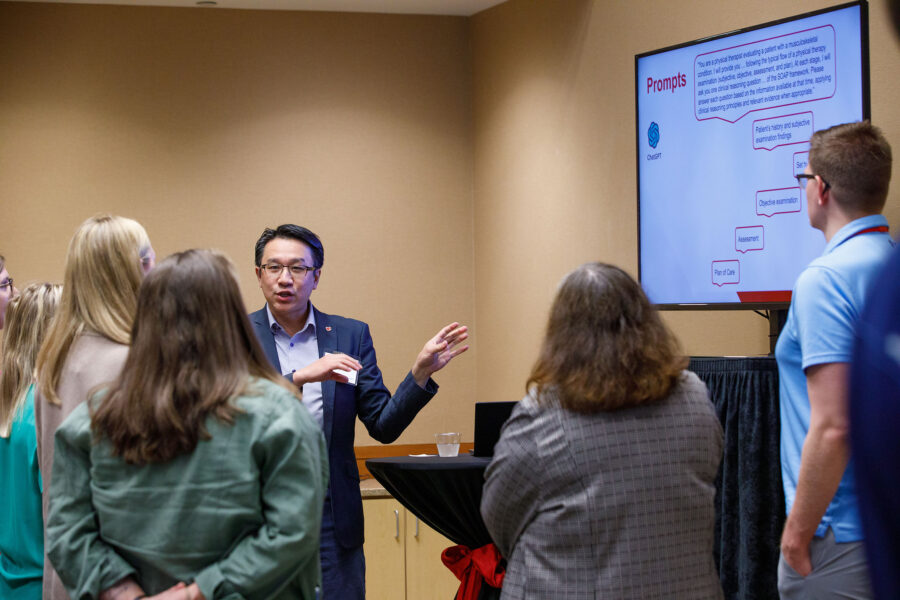
UNMC leaders across education, research and patient care showed how the institution is ready to make major advances in artificial intelligence at UNMC’s first-ever AI in health conference.
The inaugural “AI in Health Conference 2026: Shaping the Future of Care,” held at UNMC’s Truhlsen Events Center, drew some 300 attendees to hear presentations on the quickly evolving state of AI, see current research happening right here and connect with colleagues delving into the field.
The AI event ranged from the fun – emcee Pooneh Bagher, PhD, producing her own walk-up music using AI, for instance – to the deeply detailed, with some 67 healthcare-related research presentations discussing chatbots, robotics, large language models and more.
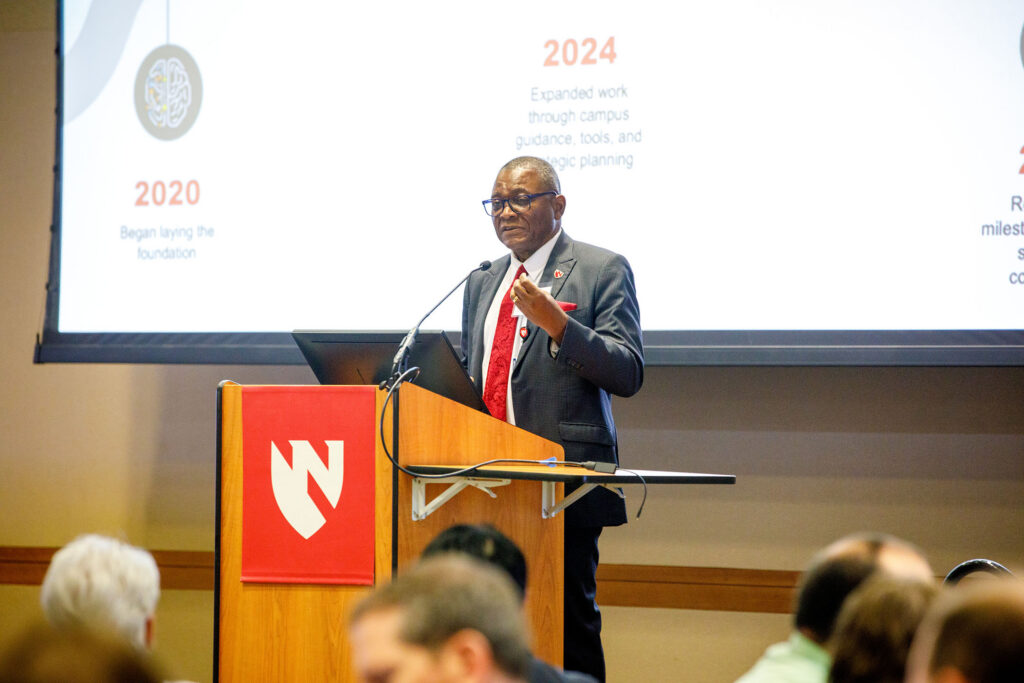
UNMC Interim Chancellor H. Dele Davies, MD, welcomed attendees from around UNMC and from UNMC’s partners, including Nebraska Medicine, Children’s Nebraska, the VA, the University of Nebraska-Lincoln and University of Nebraska at Omaha, among others.
Dr. Davies traced UNMC’s AI development from the 2018 “Big Ideas Initiative” to the 2020 creation of the Center for Intelligent Health Design. By 2023, UNMC convened its AI Task Force and has since incorporated AI into its strategic planning, all of which led to convening the AI conference, he said.
He compared the evolution of AI at UNMC to the growth of the Chinese bamboo tree. As Dr. Davies described, the bamboo tree when first planted can go years without sprouting – before growing 70 feet in the seventh year.
“There’s a lot of activity going on right now, and I believe that we are poised to grow what seems to be the equivalent of 70 feet in one year,” Dr. Davies said. “And it’s not because of overnight success – it’s because of hard work done over the years.”
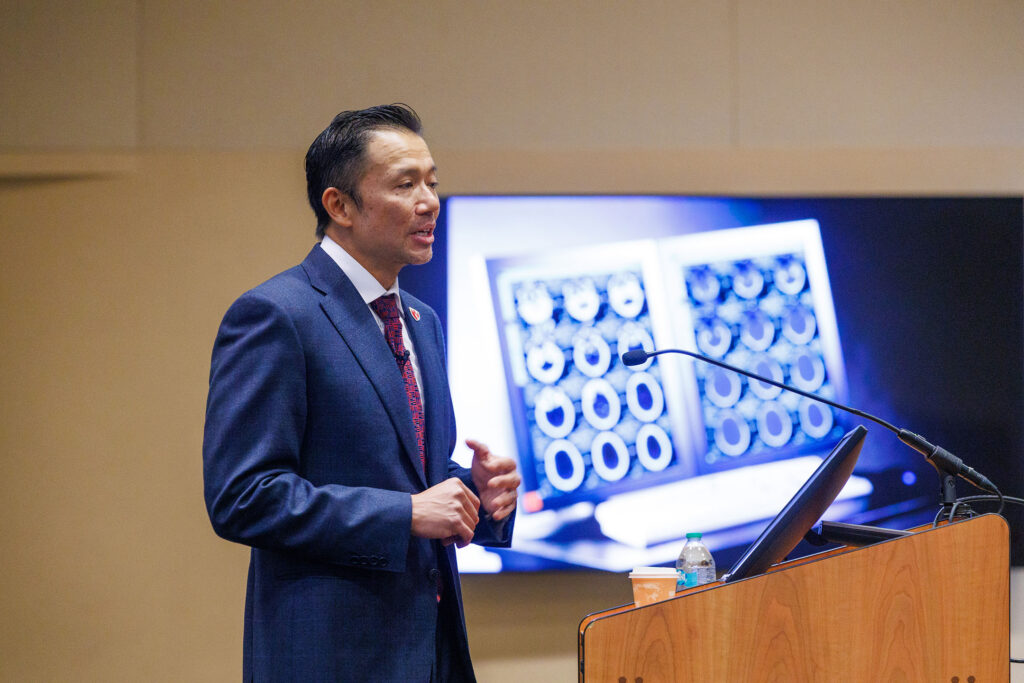
Keynote speaker Ryan Lee, MD, chair of the UNMC Department of Radiology, described some of the journey to deploying AI tools in radiology to analyze patient scans.
Dr. Lee said early predictions in the field suggested AI would put all radiologists out of work. The reality today, he said, is that he can’t hire enough radiologists.
He also offered analogies to help frame the state of AI and the adoption of new technology – as he looked back on tech’s impact on Kodak, Blockbuster Video, self-driving cars and aviation.
He concluded that the amount of good AI can do in health care is limitless – if people work together and use AI as a tool.
“In the current state of AI, you have to be vigilant,” he said, then describing his personal experience trying all kinds of technology, which often ends up not working. “That’s something you have to consider. It doesn’t mean you ignore it all together.”
The conference also included sessions on:
- Getting to know the University of Nebraska AI Institute, with co-directors Santosh Pitla, PhD and Adrian Wisnicki, PhD.
- Early experiments on the evolution of work with generative AI, with Ben Armstrong, PhD, executive director of the Industrial Performance Center at the Massachusetts Institute of Technology.
- “Vibe coding,” the term for writing computer code through AI prompts, with Victor Winter, PhD, a computer science professor at UNO.
Dr. Davies urged the attendees to build their connections.
“If you leave here with nothing more than having met somebody else who has a tool, an idea or something that you feel is going to be a value to your education, your ability to teach, your research, provide better patient care, then that’s a successful day. That is the vision,” Dr. Davies said.