The people of UNMC are making a difference.
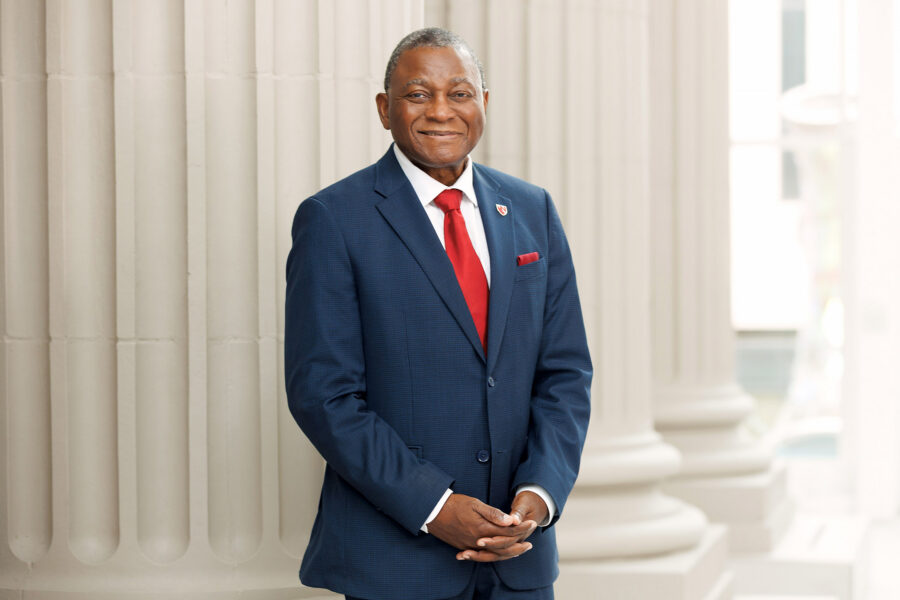
As UNMC Chancellor H. Dele Davies, MD, completes his first 100 days in the role, he said he is proud of the commitment, expertise and collaborative spirit of the people of UNMC who make its mission possible.
“I see that commitment in our classrooms, where students learn from talented faculty; in our laboratories, where researchers pursue new discoveries; in the care we provide alongside our clinical partners; and in the work of staff who make it all possible. It is also evident in the relationships we have built with communities throughout Nebraska,” Dr. Davies said. “What an incredible honor it’s been to work with so many incredible people.”
UNMC achieved several major milestones during Chancellor Davies’ first 100 days aimed at expanding educational opportunities, including:
Expanding opportunities for Nebraskans to become healthcare professionals.
Healthcare workforce shortages are “not a new problem, and it’s not a problem that’s going away,” Dr. Davies said Tuesday at his monthly campus forum. “We are addressing this on many fronts. One of my major goals is to remove any barrier that prevents any student from the state of Nebraska from becoming a healthcare provider.”
In other educational achievements in Chancellor Davies’ first 100 days:
- Enrollment reached 4,847 for fall 2026, the 26th consecutive year of growth; more than 75% of students are from Nebraska.
- The UNMC College of Medicine welcomed its first Kearney cohort, empowering Greater Nebraska students to train and practice closer to home.
- The UNMC College of Pharmacy began its second Kearney cohort, while also announcing a six-year PharmD option beginning in 2027 for students who need to balance their education with employment and family responsibilities. A new partnership with Clarkson College also establishes additional pharmacy education pathways.
- The UNMC College of Nursing’s BSN program earned a top-30 national ranking, another recognition of educational quality and faculty commitment, and the college has signed MOUs with a number of Nebraska high schools to provide a path to UNMC’s program.
- UNMC mounted a successful effort to find loan alternatives when federal graduate loan program opportunities were reduced. So far, 119 students have secured private loans through lenders UNMC worked with to expand financing options for students.
- The UNMC College of Public Health marked its 20th year on July 28 — two decades that have seen it grow into an internationally recognized vanguard for public health education, research and frontline response.
A resilient, innovative and increasingly collaborative research enterprise.
The UNMC Office of Industry Relations and the newly formed UNMC Office for the Advancement of Military Medicine have been important steps in allowing UNMC both to diversify revenues in research and to help build an already robust partnership with the U.S. military.
Other research highlights of the first 100 days:
- Research-specific awards rose 35% to more than $230 million in FY26, and all sponsored awards rose to nearly $290 million, a 30% increase. These results are particularly noteworthy given the uncertainty surrounding federal research support, reflecting efforts to diversify funding, develop industry relationships and help investigators pursue new opportunities.
- In September, the UNMC-led Great Plains IDeA Clinical and Translational Research Network received a five-year NIH grant exceeding $25 million. The network connects UNMC with other universities, Nebraska Medicine, Children’s Nebraska, Boys Town, the VA and additional partners to expand collaborative research.
- The College of Dentistry reported more than $5 million in extramural research funding in FY25, an increase of more than 500% over three years.
A demonstrated commitment to Nebraska, amplified by strong relationships and trust across the state.
“Nothing has energized Greater Nebraska and increased the goodwill and the perception of UNMC as the fact that we’ve expanded our campus at Kearney,” Dr. Davies said. “We’re going to more than double the number of healthcare professionals we’re training in Kearney, to over 640, which will it make the largest academic health center in rural America.”
In addition to increasing UNMC’s presence in Greater Nebraska, the university grew outreach efforts, such as:
- Community-centered health services, such as September’s One Stop Cancer Shop in North Omaha brought community and faith leaders, Nebraska Medicine, nursing students and the NCI-designated Fred & Pamela Buffett Cancer Center together to provide screenings and other services.
- A new initiative led by Ann Anderson-Berry, MD, PhD, received $2 million in first-year funding to improve maternal and neonatal health outcomes, with a particular focus on rural communities. Meanwhile, the UNMC College of Public Health welcomed its first students for its Maternal and Child Health concentration in the Doctor of Public Health program.
- UNMC’s College of Dentistry also received funding to strengthen rural dental access, including opening an urgent dental care clinic and expanding outreach.
A leaner, more effective enterprise through the Better Processes Initiative.
“The first goal of process improvement is to look at all the things we’re doing every day and ask: Is this working the way it should?” Dr. Davies said. “We have a $1 billion enterprise. If we can save 1%, that’s $10 million.”
UNMC is building a culture of continuous process improvement, intended not only to lead to savings and increased revenues, but to better satisfaction among staff and patients. Pilot projects at the UNMC College of Dentistry and Human Resources are successful examples that are part of a broader strategy to use automation, to look for new sources of revenue, and to empower employees to identify opportunities to work more effectively.
Innovative solutions to complex healthcare challenges.
Referencing the selection of John Windle, MD, as UNMC’s first associate vice chancellor for healthcare artificial intelligence, Dr. Davies said, “AI is not the future. AI is here.” A new campus AI steering committee will also help steer the campus to getting the maximum value out of AI.
Work over the past few years, he said, has been aimed at making sure that “AI helps our researchers do better research, helps our students to learn better, and helps our clinicians to do better work and also improve our processes.”
Other milestones during the first 100 days that highlight UNMC’s innovation included:
- The September groundbreaking for the $17.4 million Infectious Disease Air Transport training facility, in addition to the launch of the Office for the Advancement of Military Medicine, represents an expansion of UNMC’s role in national health security and military medical training. The partnerships with the government, including the National Strategic Research Institute and C-STARS, will help keep UNMC on the cutting-edge.
- In August, UNMC, Nebraska Medicine and the Fred & Pamela Buffett Cancer Center celebrated a decade of CAR T-cell therapy. The October Board of Regents meeting also highlighted the transplant program’s achievement of its 10,000th transplant.
- UNMC’s Munroe-Meyer Institute recently expanded its primary care services for children with intellectual and developmental disabilities.
Looking ahead
As UNMC and the University of Nebraska-Lincoln look for opportunities that joint accreditation will provide, and as Nebraska Medicine governance solidifies, there will be great value in working together, Dr. Davies said. “We are committed to removing barriers and streamlining collaboration.”
Other opportunities looking ahead include:
- UNMC and Nebraska Medicine’s new shared-governance structure with the Omaha Community Foundation provides a framework for an effective and innovative next phase of the clinical partnership.
- The Board of Regents’ Oct. 9 approval of an expanded Project Health also represents a major long-term investment in clinical education, research and care. Its approved scope is now approximately 1.5 million square feet, with an anticipated cost of $2.75 billion.
“Our greatest strength has always been our people,” Dr. Davies said. “That gives me great confidence in what we can continue to accomplish together for Nebraska and beyond.”